
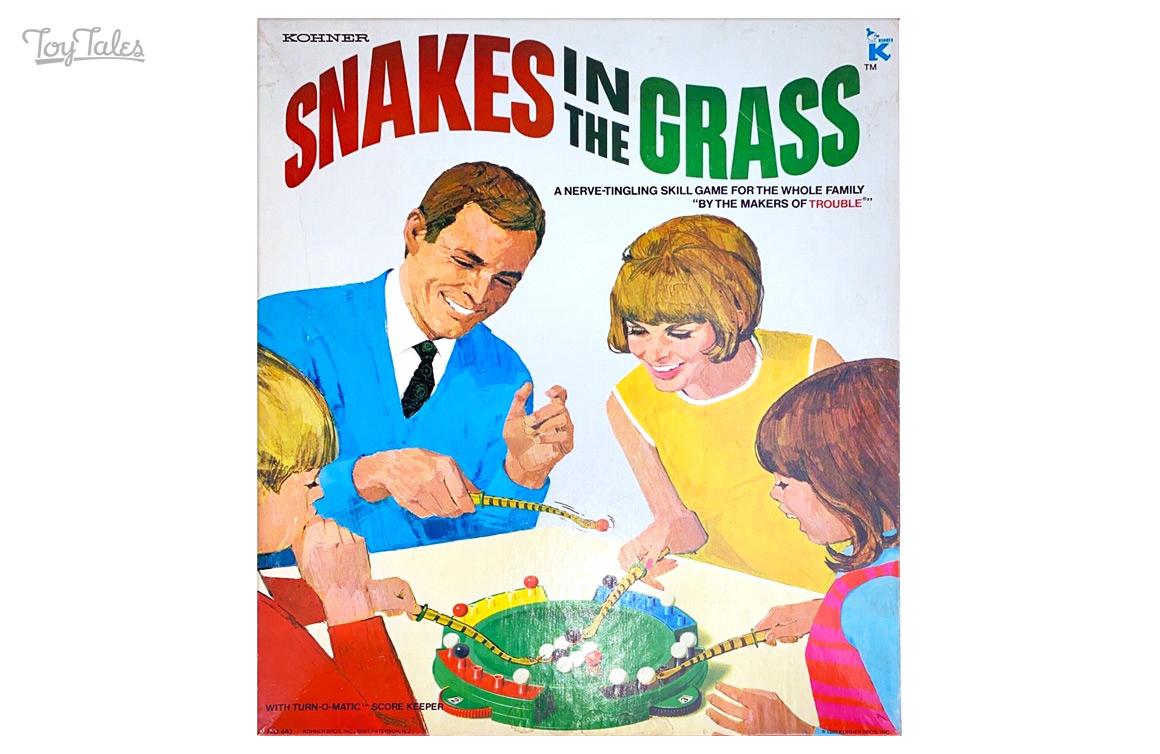
Released by Kohner in 1969, Snakes in the Grass combined dexterity, speed, and hand-eye coordination in a race to collect a clutch of snake eggs.
GAMEPLAY
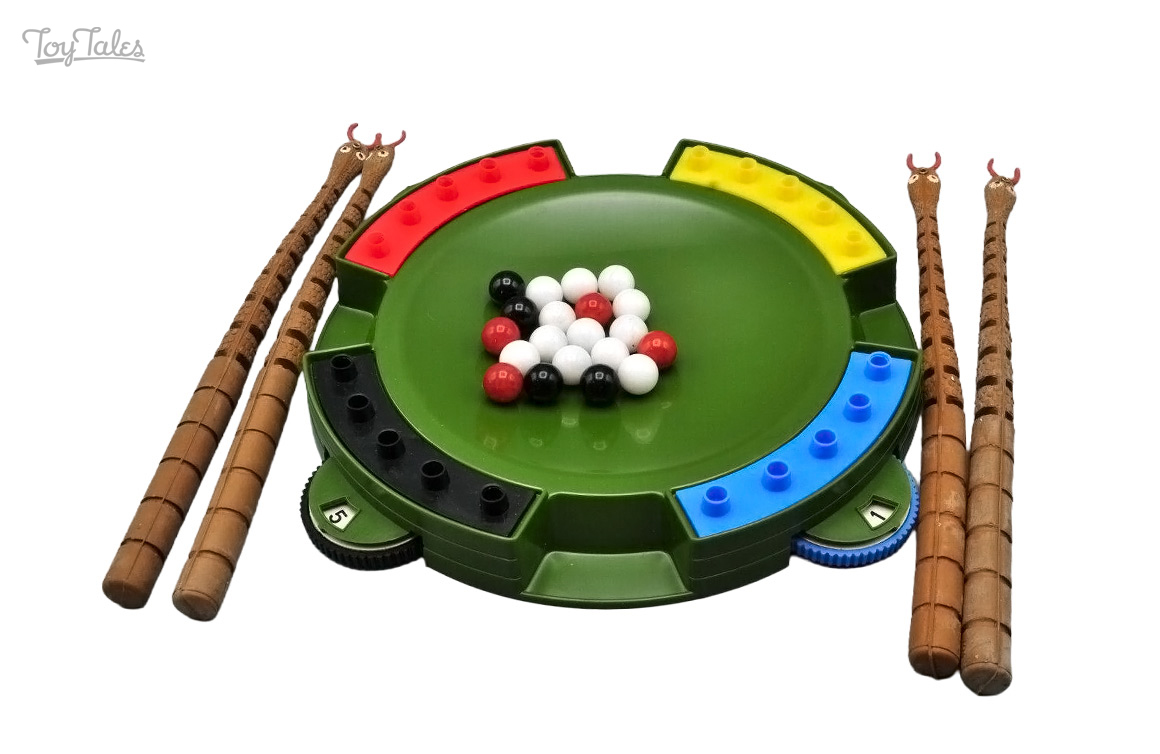
The game board had four designated player regions, each with a turn-o-matic score keeper and a coloured platform (red, blue, yellow, and black) for holding collected eggs.
Players competed to collect five snake eggs from the grass, a recessed area at the centre of the game base, using a plastic snake with a crescent-shaped tongue. Each snake featured a spacer disc that served as a hand stop, reminding players to keep their hand behind the disc to ensure everyone had the same reach and to maintain a level playing field.
A game consisted of multiple rounds. At the start of each round, players attempted to scoop eggs from the centre of the playing area, balance them on their snake’s tongue, and transfer them to their own nest. Because the eggs could easily fall off the tongue, players needed both speed and a steady hand.
Once a player filled their nest with five eggs, they called aloud “snakes in the grass!” and the round ended. Points were awarded based on the colour of the eggs collected, with black eggs worth the most (four points), followed by red (3 points), and white (one point). The player with the highest score won the round, and the first player to win five rounds claimed victory.
IN THE BOX
A complete game included the game base, four snakes, 20 snake eggs (black, red, and white marbles), and four spacer discs. Game instructions were printed on the back of the box top.
COLLECTOR CONSIDERATIONS
Snakes in the Grass is an example of a game that used marbles as a central component of play. Marbles were a staple of many vintage games, adding visual appeal, tactile gameplay, and a satisfying clatter. Other examples include Whiplash from Lakeside, KerPlunk from Ideal, Mad Marbles from Lakeside, Mr. Mad from Ideal, and Payoff Machine from Ideal.
Although marbles aren’t particularly fragile, they can get lost, making it challenging to find vintage games that include the originals. Easy to replace, vintage games with missing marbles can still be worth adding to a collection.

Note: If you buy something using the eBay link in this story, we may earn a small commission. Thank you for supporting independent toy journalism!