 Happy Wonder Woman Day!

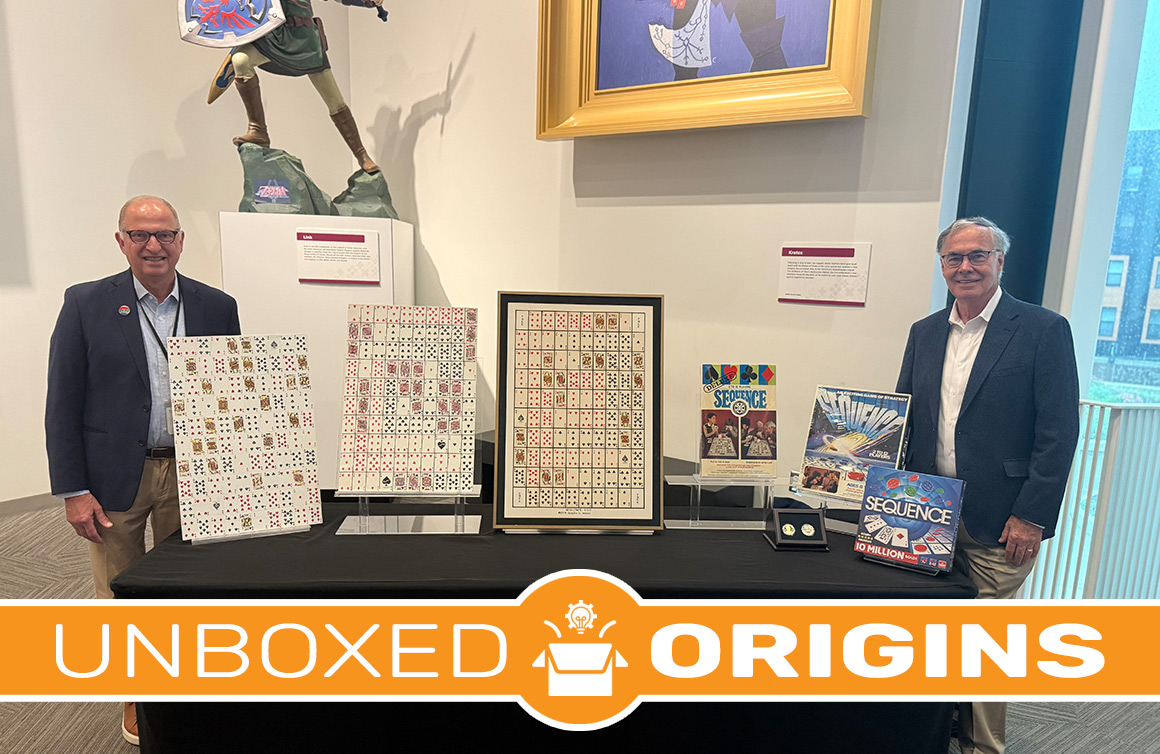
Few modern board games have enjoyed the lasting success of Sequence. First published by Jax in 1981, the game combines playing cards with a strategy board, challenging players to complete rows of chips while blocking their opponents from doing the same. Straightforward enough for newcomers yet engaging for experienced players, Sequence has remained a fixture at game nights and in collections for more than four decades.
BORN IN A DREAM
The game’s origin story is an unusual one. Invented by board game designer and former Minnesota state legislator Doug Reuter, Sequence began as an idea that came to him in a dream in 1974, prompting him to wake up and write it down before the concept faded from memory. Reuter then set about building the game by hand.
FROM PROTOTYPE TO PRODUCT
Turning the idea into a finished game proved more challenging than dreaming it up. Reuter recalled that Sequence, originally named Sequence Five, took four years to develop, followed by another three years to secure a publishing agreement and nearly a year before it reached store shelves.
Along the way, he built handmade prototypes from playing cards glued to cardboard, testing and refining the design. Many of the game’s defining features, including the special roles of the one-eyed and two-eyed jacks, emerged through the testing process.
PRESERVING HISTORY
Today, those early stages of the game’s development are preserved at The Strong National Museum of Play in Rochester, New York. Reuter donated dozens of artifacts documenting the evolution of Sequence, including four original prototypes, a replica of his first handmade board, later development versions, and his original 1981 publishing contract with Jax.
The donation also features several editions of the finished game, along with materials from other designs Reuter created, including Futility, QB8, and Zigzaggle. Mirek Stolee, curator at The Strong, noted that Sequence has sold more than 10 million copies since 2018, describing the prototype collection as an opportunity to trace the game’s journey from a dream to a family favourite.
A LEGACY OF PLAY
More than 40 years after reaching store shelves, Sequence continues to find new audiences thanks to its current publisher, Goliath Games, while remaining a favourite among longtime players. Its longevity is notable in an industry where relatively few games remain in circulation for decades.
Reuter’s donation to The Strong adds another dimension to that legacy by documenting the process behind the finished game. Together, the prototypes, development materials, and commercial editions trace Sequence from a handwritten idea inspired by a dream to a game played by millions.