


Before it was Boggle, Allan Turoff’s word-finding game had a much more straightforward name: Find-A-Word.
Turoff developed the game around a simple challenge. Players were presented with a random arrangement of letters and raced against the clock to find as many words as possible by connecting adjacent letters.
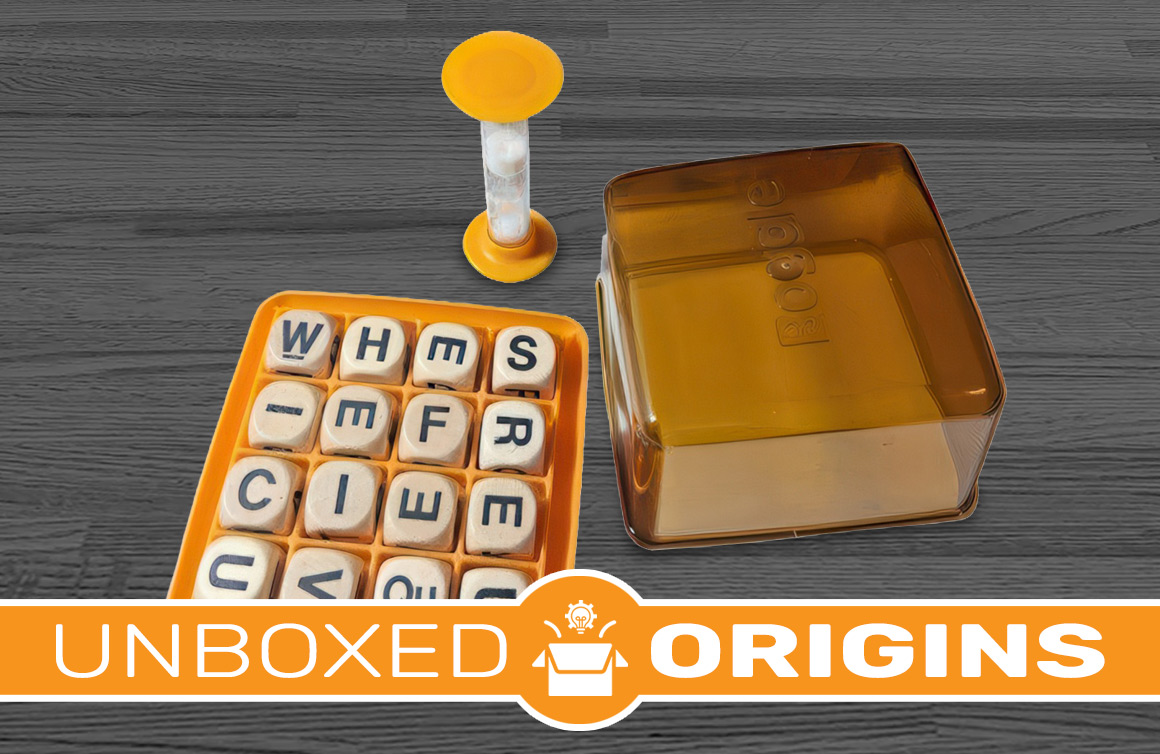
The original handmade prototype reflected the basic concept that would eventually become familiar to generations of Boggle players. Letter cubes provided the constantly changing combinations at the heart of the game, while a sand timer added the pressure of playing against the clock.
In 1970, Turoff took Find-A-Word to Parker Brothers in hopes of bringing his invention to market. The company rejected the game.
For the time being, Find-A-Word went no further.
FROM REJECTION TO BOGGLE
Two years later, Parker Brothers reconsidered Turoff’s invention. The company renamed the game Boggle and released it in 1972 alongside two other games.
Boggle challenged players to shake a covered 4×4 grid containing 16 letter cubes. Once the cubes settled, players had three minutes to identify words by connecting adjacent letters horizontally, vertically, diagonally, and around corners. When time expired, duplicate words were eliminated and points were awarded for the remaining words based on their length.
Despite its simple premise, Boggle was not an immediate commercial success. Sales of the games released alongside it were lacklustre, but Boggle attracted a small and dedicated following.
FINDING AN AUDIENCE
That following gave Boggle another opportunity. Parker Brothers re-released the game in new packaging in 1976, followed by an advertising campaign in 1977 that helped sales take off.
The game’s success eventually led to variations including Big Boggle, which expanded the playing grid to 5×5 letter cubes, and Pocket Boggle, a compact version designed for travel.
Photographs of the original prototype, preserved by the Turoff family, provide a glimpse of the game before it became Boggle, complete with the letter cubes and sand timer that would remain central to the game. They also document an early stage in the development of a game that would eventually become a family game night staple.