


How did your interest in Hess toy trucks start?
It was 1977, and I was five years old. My dad came home from work one evening and said, “Get your coat, we’re going in the car.” We lived in the Bronx, and he took me to the Hess station on Tremont Avenue in the Bronx.
I remember walking in and thinking I was in heaven. Everything was white, bright, and spotless. We had a family mechanic named Rocco, and his shop was always covered in grease. I asked my dad how the station could be so clean, and he explained that they only sold gas; they didn’t repair cars. As a five-year-old, I felt like it was a big revelation.
That’s where he bought me my first Hess truck, the 1977 tanker.
Not long afterward, my dad developed myotonic dystrophy, a form of muscular dystrophy that slowly weakens every muscle in the body while leaving the mind intact. For much of my childhood, I helped care for him as his condition worsened.
After he passed away in 1991, every time I drove past a Hess station, I thought of him. It gave me a good feeling, and I began buying the annual Hess truck to remember him.
Back then, Hess trucks were a holiday tradition. They appeared around Thanksgiving, disappeared after Christmas and then you wouldn’t think about them again until the following fall. Every October or November, it was, “Oh yeah, it’s Hess truck time.”

What inspired you to document the history of the toys?
The story really begins in 2010. I had been a banker in New York City and, like many others during the financial crisis, found myself unemployed. I went back to school and suddenly had something I hadn’t had before: time.
I was broke and had time, so I opened Google. It was like the man behind the curtain in The Wizard of Oz. I started thinking, “What have I always wanted to know about?” And I thought: Hess trucks. My dad. Hess trucks.
I started Googling, and within the first 10 minutes, I noticed discrepancies. One website said they made 600 pieces of a particular model. Another website said they made 3,000 of the same model. I was like, “Whoa, whoa.” So, with the ADD brain I have, I started taking notes in a standard Word document about each model year and everything. Before I knew it, I had a couple of hundred pages.
What struck me was that almost all the information available came from dealers who were buying and selling trucks. The deeper I researched, the more inconsistencies I found.
Around 2011, I discovered Hess had a Facebook page. I started asking questions, but even they couldn’t answer many of them accurately. Eventually, they admitted they simply didn’t know.
Around that time, I connected with another collector, James. I sent him my research, and within minutes he replied, “Oh my God, you have no idea what you have. You have to get this out there.”
That was when I realized nothing like this existed.
Before eBay and the internet, collectors depended on toy shows. If someone told you a truck was worth thousands of dollars, you had very little way to verify it. As I shared my research, more people began telling me about expensive mistakes they had made, and a small community started forming around the project.
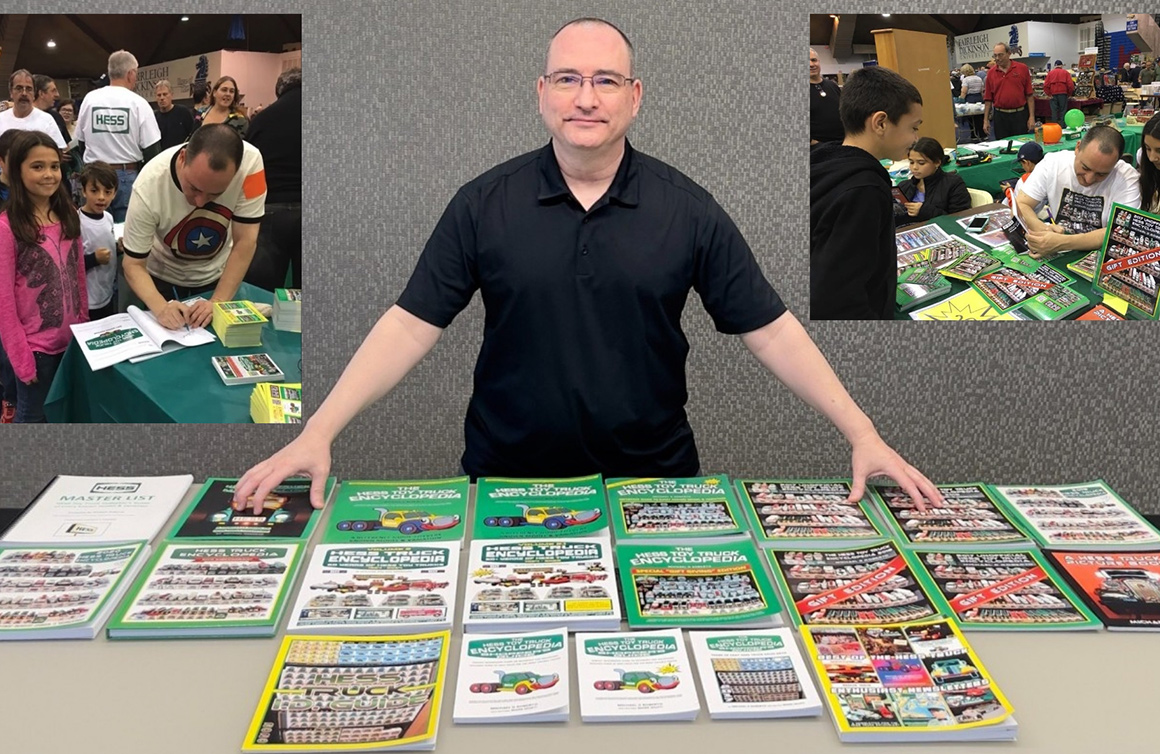
People kept encouraging me to publish it. Eventually, I found a printer, explained exactly what I was trying to do, and 74 collectors mailed me cheques in advance, allowing me to produce the first edition. At the time, it was called The Master List before eventually becoming the encyclopedia.
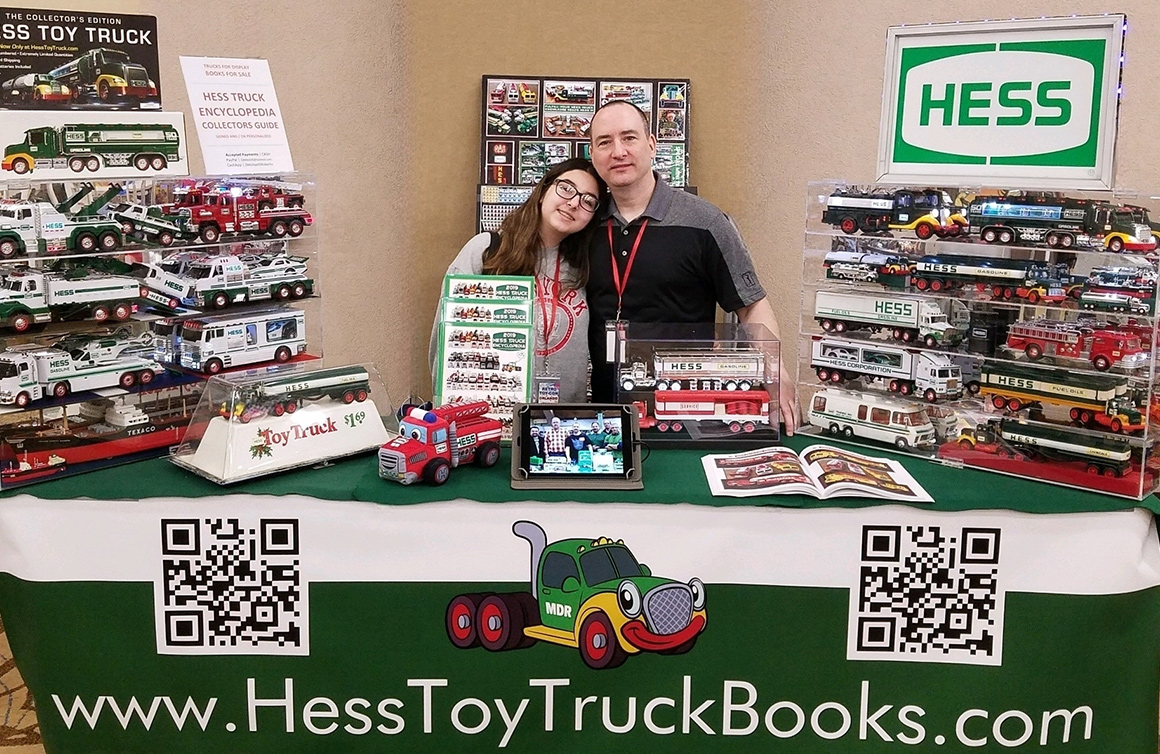
Things really changed after Bill Lango invited me to his toy show in New Jersey, not far from Hess headquarters. Toward the end of the show, a man working security pointed to one of my trucks and said he had the same one in a red box.
I told him they only came in green boxes.
He went home and returned with it.
When I saw it, my jaw dropped. It was a prototype that he had bought on eBay for $25. I photographed it, documented it, and years later, it sold for about $4,000.
But the moment that stayed with me happened earlier that day.
An older collector came to my table and said, “I thought I had everything. I stopped collecting because it wasn’t fun anymore. Then you showed me trucks I never knew existed. You brought the thrill back.”
Looking into his eyes, I didn’t see an older man. I saw a five-year-old kid.
That was when I realized this work actually meant something to people.
Over the next six years, attendance at the show grew from a few dozen people stopping by my table to nearly 1,000 people. Unfortunately, the promoter passed away, and COVID soon followed, bringing that chapter to an end.
One image has stayed with me through all of this: a grandfather standing beside his son, who was holding his own son, four generations connected through Hess trucks.
I realized that when it comes to family, the truth is we all want to be remembered. For many people across New York, New Jersey, and Pennsylvania, Hess trucks have become part of that tradition.
In the early 1990s, demand became so intense that people lined up before dawn on Thanksgiving morning to buy the newest truck. The crowds grew so large that the New Jersey State Police had to manage traffic, and Leon Hess eventually moved the release date earlier to reduce congestion.
By 1994, Hess had dramatically increased production to discourage hoarding and ensure more families could buy the trucks.
Today, everything happens online, but it’s different.
Buying online reminds me of the difference between listening to an MP3 and playing a vinyl record. With a record, there’s anticipation. You pull it from the sleeve, place it on the turntable, lower the needle, and wait. That ritual is part of the experience.
That’s one reason my books have always been print only. Hess collectors are tactile people. I want them to hold a book, flip through the pages, and enjoy the photographs instead of scrolling on a screen.
At one point, I owned three of every truck: one mint in the box, one on display because I loved seeing the lights, and one loose that visitors could actually pick up and handle. I always thought that covered all the bases.
What surprised you in your research?
Once I started sharing information and documenting different versions of the trucks, people began contacting me, saying, “I didn’t know there were two versions of that,” or “I had no idea that variation existed.” Every discovery seemed to lead to another.
One of the first people I connected with was a collector named Mark, who remains one of my closest contacts today. When I was preparing my first book, I needed a cover photo showing every Hess truck released to that point. I asked if he’d be willing to photograph his collection.
I honestly didn’t expect him to say yes.
He replied, “No problem. I’ll do it Sunday.”
That meant taking more than 50 trucks out of their boxes, arranging them, photographing them, and then carefully putting them all away again. It took him an entire day.
I remember him saying, “Mike, any excuse to take the trucks out of their boxes.”
That really stuck with me.
As the project grew, I started asking other collectors for help, and they were just as generous. I visited collections across the country, sometimes spending entire weekends photographing rare trucks for future editions of the book.
It became a self-fulfilling cycle. The more new information I published, the more collectors came forward with pieces I’d never seen before.
The reason I’ve reached the level I have, and I’m always careful not to come across as a know-it-all, is simple.
I never assign values.
If someone asks what a truck is worth, I tell them that’s not what I do. What I can tell them is that 90 percent of the 1987 trucks were made in Hong Kong and 10 percent were made in China. If you happen to own the Hong Kong version, you can draw your own conclusions.
I stick to the facts.
Because I don’t buy or sell trucks, I don’t have any conflicts of interest. I do this out of passion, and I think that’s one reason people trust my work.
Collectors have written to tell me, “You’ve done more in two years than people have done in the last twenty.” Those comments meant a lot to me. I included many of them in the early editions of the book because they reminded me I was doing something worthwhile.
It’s nice to have that little spotlight. More than anything, it’s nice to know the work is appreciated.
How have the designs evolved over time, and what do those changes reflect?
That evolution has shaped the designs more than anything else.
The 1960s were all about experimentation. The trucks from that era are unlike anything that followed.
The 1970s continued that innovation, although the oil embargo affected production, and there were a few years without a new truck.
Collectors generally consider 1964 through 1986 to be the vintage era. Beginning in 1987, the trucks adopted the modern white styling, and the designs became more imaginative. Instead of simply recreating Hess fleet vehicles, they introduced things like race cars and transporters that had no connection to the company’s actual business.
One example always makes me laugh.
The 1994 emergency truck was originally designed as a tow truck, but Leon Hess reportedly decided against it because he didn’t want customers thinking Hess offered towing services.
Then, the following year, they released a Hess helicopter.
I always joke that I’m still waiting for my helicopter ride.
While the holiday trucks became more child-friendly, Hess also recognized that many of us had grown up with them.
In 2014, they introduced a collector’s edition tanker, and they absolutely did their homework. The detail and quality were exceptional.
People sometimes say the trucks are made for kids now.
My response is always the same: they were *always* made for kids.
The difference is that we’re adults now.
Child safety laws have changed what manufacturers can produce, but nostalgia also changes how we remember the toys we grew up with.
Today, the line serves several audiences. There are the traditional holiday trucks, the collector’s editions for longtime enthusiasts, miniature trucks, and even plush Hess trucks designed to be safe for newborns.
No matter which version you’re talking about, I still think they’re a remarkable value. The quality, lights, sounds, and durability are hard to match.
It’s funny when you think about it. An oil company produces them, yet generations of children know the Hess name long before they understand what oil is.
That says something.
When Chevron acquired Hess Corporation, many people worried the toy truck tradition would disappear. The concern was so widespread that company executives addressed it directly during the announcement, reassuring everyone that the trucks would continue.
That’s what people really wanted to know.
It says a lot that, during discussions about a multibillion-dollar corporate acquisition, one of the biggest questions was, “What happens to the Hess Toy Truck?”
It has become something much bigger than a promotional toy.
How has the collector community responded to the books?
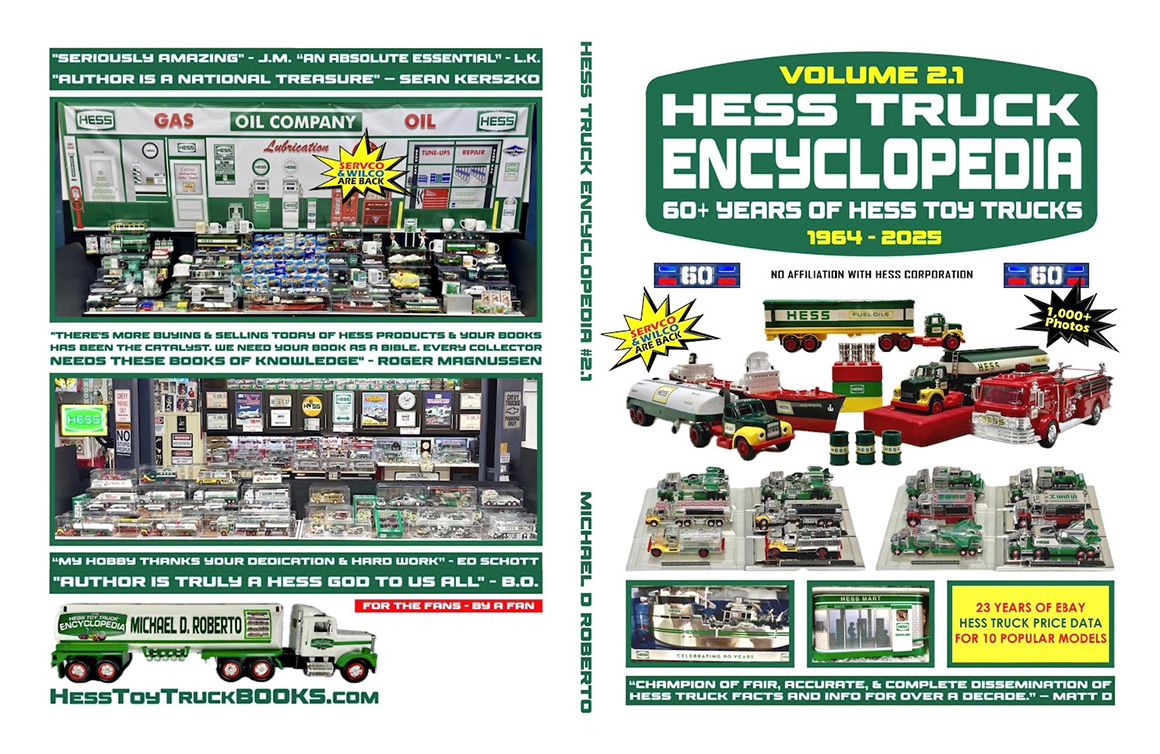
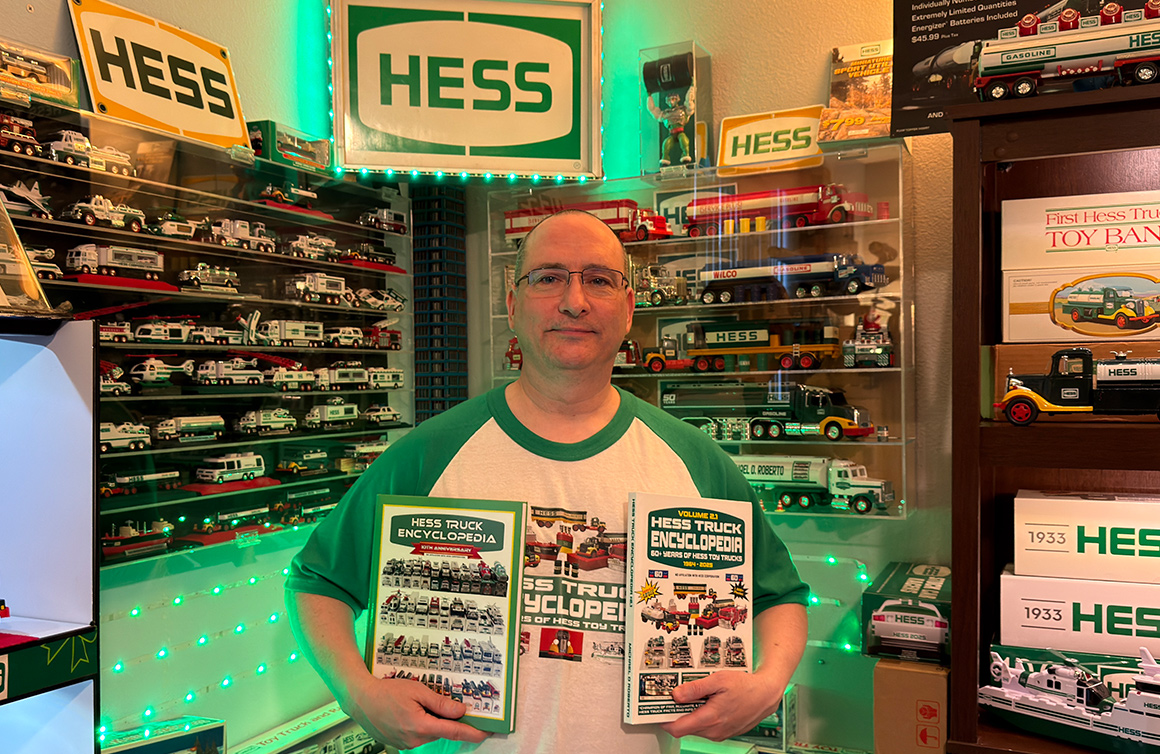
One quote from the back cover of my latest edition, Version 2.1, really sums it up:
“There’s more buying and selling today of Hess products, and your books have been the catalyst. We need your book as a bible. Every collector needs these books of knowledge.”
That was from Roger Magnussen.
What I’ve really done is connect people.
I connected the collector who paid what was then a record $12,000 for a Hess truck. That sounds crazy to most people, but for advanced collectors, it’s all about the rarest variations, the clear versions, the silver versions, and the executive-only releases. Those are the trucks worth thousands of dollars.
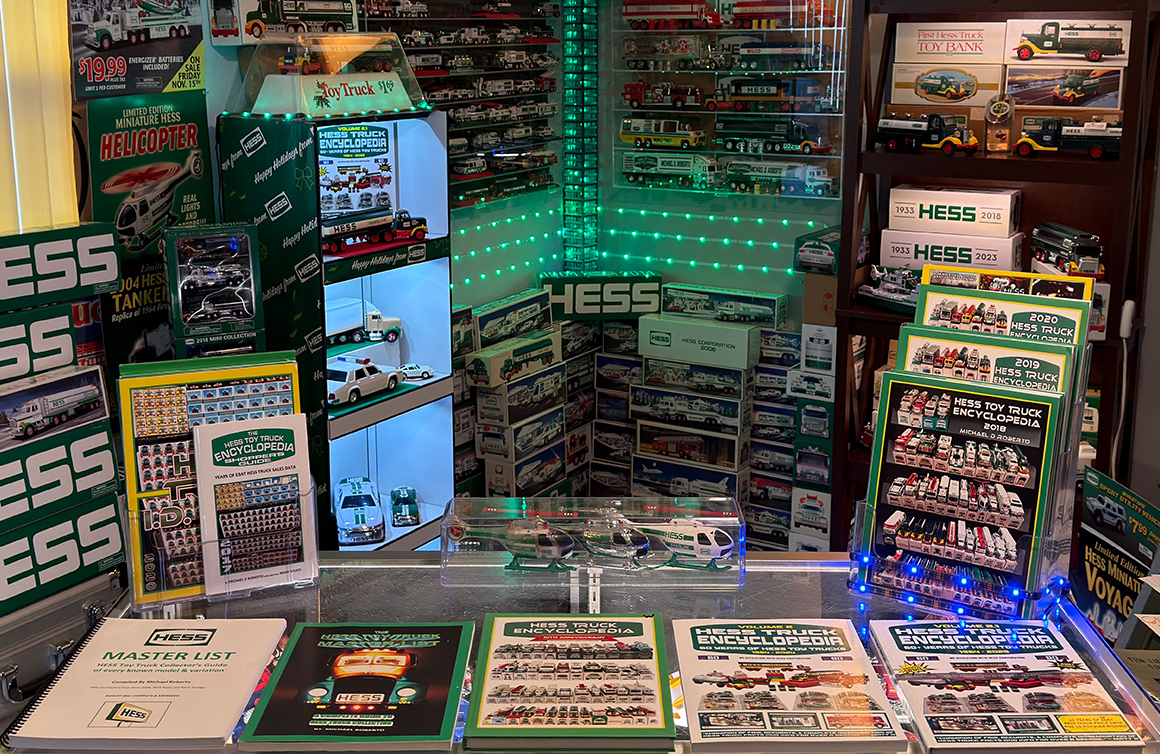
One of the best examples is a collector named Ed. If you watch my YouTube video *Ed’s Garage*, you’ll see one of the finest Hess collections anywhere. Every time I visit, I’m like a kid in a candy store. He owns one-of-a-kind pieces that I photograph for the books, including executive-only prototypes that most collectors will never see.
Some of these trucks are so rare that even Hess asked me where collectors had found them.
I never ask questions. I don’t get involved in ownership or provenance. I simply document what exists.
Many of these rarities surface through estate sales. As the original owners pass away, pieces that were never publicly known begin entering the hobby. My books have helped collectors recognize those variations and understand what they’re looking at.
One collector once called me and said, “Mike, promise me you won’t bid on this eBay listing.”
I promised.
Fourteen thousand dollars’ worth of Hess trucks sold for $27 because the seller had no idea what they had. They listed them as “Hess trucks.”
I included that example in the book because it’s the perfect illustration of why documentation matters.
Sometimes the difference between a truck worth a few hundred dollars and one worth several thousand is a tiny detail. Take the 1967 and 1968 trucks. They look almost identical, but the 1967 version has no logo on the battery cover because it was made in the United States. The 1968 version, made in Hong Kong, does have the logo. That one small difference changes the value dramatically.
That’s why people trust my work.
I don’t buy or sell trucks. I simply present the facts and let collectors make their own decisions.
I also remind people that these books are completely self-published. I make very little on each copy. They’re expensive because high-quality colour printing is expensive, not because I’m trying to make money.
People often ask why I don’t advertise.
The answer is simple: it’s a passion project. Everything has grown through word of mouth.
When I released Version 2.1, I honestly thought I was finished.
Then collectors started contacting me again.
Now I already have another twenty pages of new material for Version 2.2.
Writing the book is only half the work. The other half is photography, layout, and trying to fit everything into a book that’s already pushing the limits of what can fit into a shipping envelope.
I expect Version 2.2 to be released around October or November 2026, alongside the new Hess truck.
It’s a tremendous amount of work, but it’s worth it.
People tell me the books matter to them, and that’s really my emotional currency.
When Hess trucks moved online, the community lost the experience of gathering at the stations every holiday season. During the years we held the toy shows, people found that sense of community again.
I used to tell them, “The stations are gone, but come to the show. Buy a truck. Buy a book. Bring your kids. They’ll remember it.”
To me, that’s what this has always been about.
Explore Michael’s work to preserve the history of Hess Toy Trucks on his website. Hess Toy Truck Encyclopedia 2.1 is available for purchase on Amazon.