
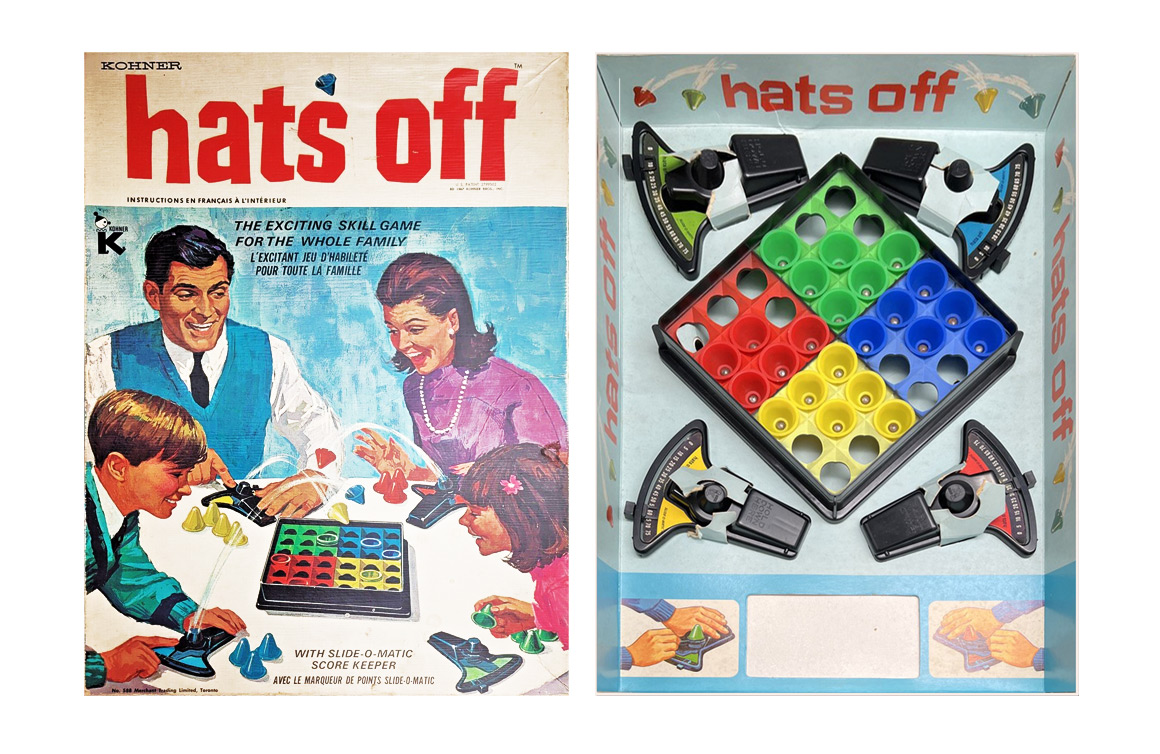
“The exciting skill game for the whole family.”
Released in 1967 from Kohner, Hats Off was a fast-paced action game in which players competed to land their set of plastic hats into a designated grid area to score points.
GAMEPLAY
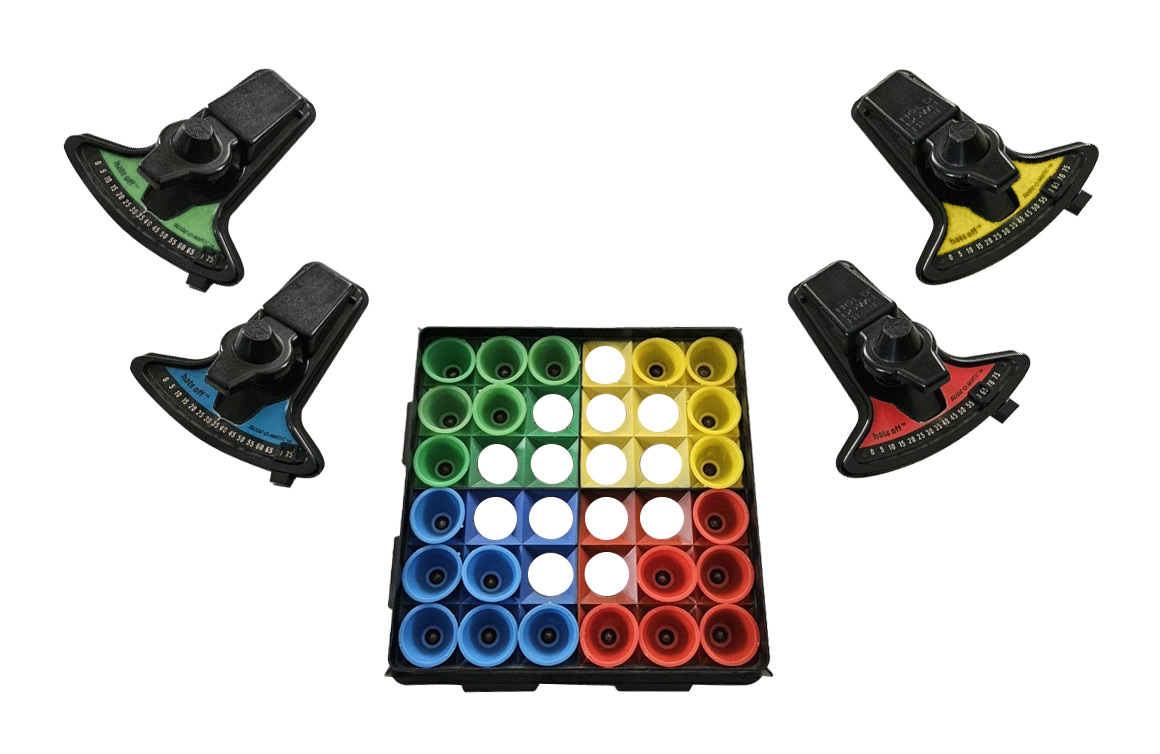
Players gathered their set of six coloured hats and a launcher. The playing board was divided into target quadrants, each corresponding to a specific hat colour. Players positioned themselves at the opposite corner of their assigned target area. Each quadrant contained nine holes intended for landing hats.
To begin a round, one player announced “ready-set-go.” All players then acted simultaneously, repeatedly placing a hat on their launcher and propelling it toward the game board, aiming to land it point-down in one of the holes withing their designated quadrant. Each hat contained a small internal bearing designed to improve stability and increase the likelihood of a successful landing.
The first player to launch all six hats called “hats off,” ending the round. Scoring was based on hat placement and configuration. Five points were awarded for each hat successfully landed in the player’s own quadrant. Additional points were earned by stacking hats, either one’s own or an opponent’s, that landed in another player’s region. A player could score up to 25 points in a single round. Hats that failed to settle within the correct quadrant scored no points.
Players announced their points before beginning the next round and recorded them using the slide-o-matic scorekeeper built into each launcher. The first player to reach 75 points won the game.
IN THE BOX
A complete game included a playing board, four launchers, and 24 hats, six each in red, blue, green, and yellow. Instructions were printed inside the box top.
ABOUT KOHNER
Kohner Bros. began as a wooden bead manufacturer in Czechoslovakia. Members of the Kohner family emigrated to Brooklyn, New York, where the company re-established operations in 1940. In its early years in the United States, Kohner produced bead-making kits and wooden pull toys before expanding into plastic toys and games. Its product line included well-known items such as Busy Box, Shapees, Sketch-O-Matic, and TV Wiggle Blocks.
Kohner was also known for developing the Pop-O-Matic line of board games, including Trouble, Headache, and Pop-Dog. These games featured the Pop-O-Matic mechanism, nicknamed Pop’ee, a clear plastic dome enclosing a die that players activated by firmly pressing on the dome, producing the distinctive “pop” sound that became a defining feature of the brand.

Note: If you buy something using the eBay link in this story, we may earn a small commission. Thank you for supporting independent toy journalism!