
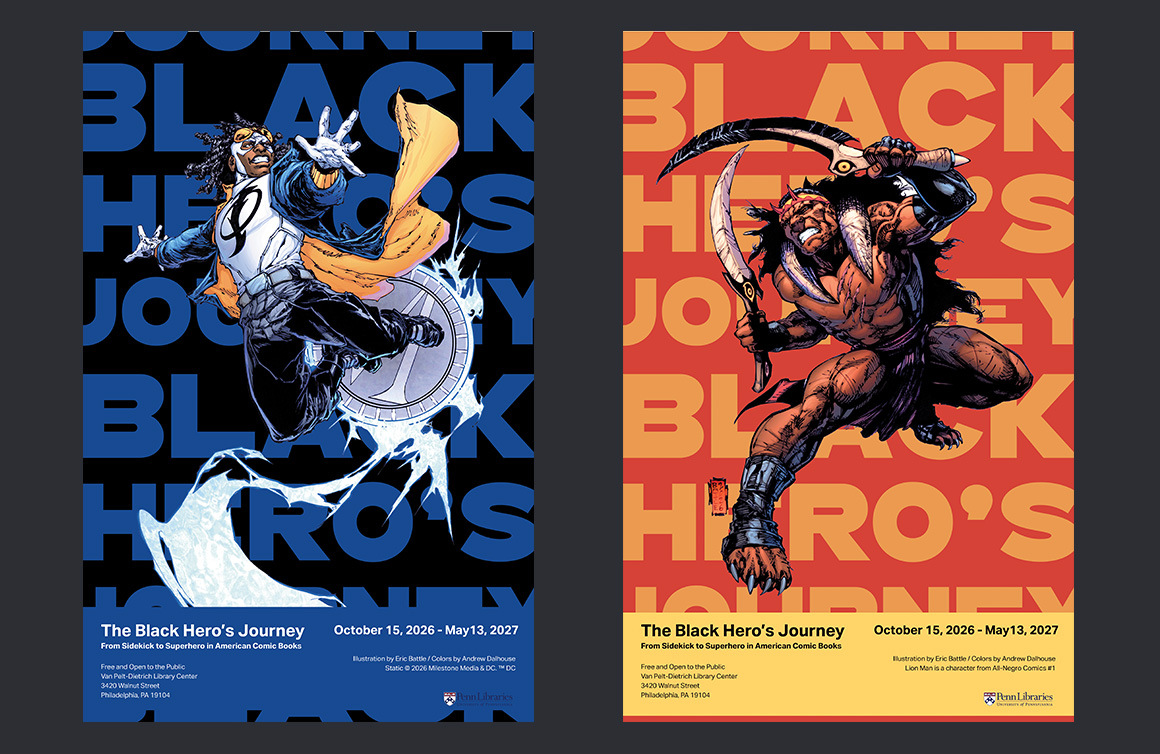
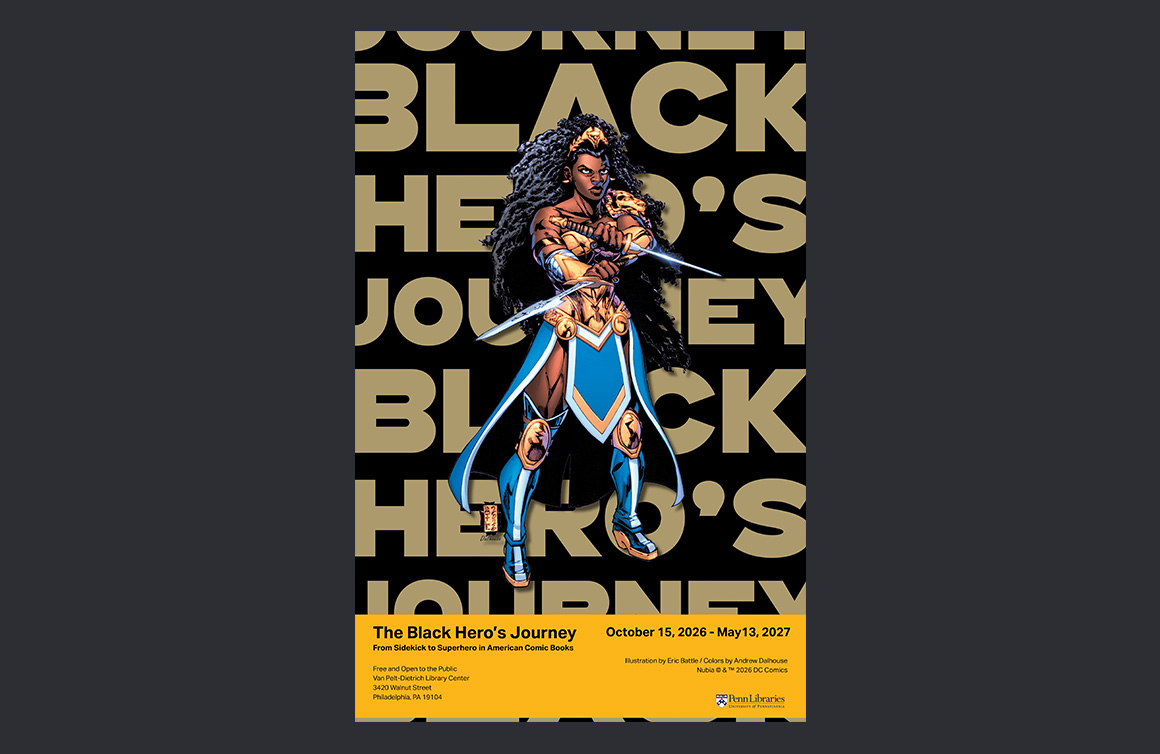


What inspired The Black Hero’s Journey exhibit?
Chaz: There’s a 40-year origin story, and then a 40-week origin story.
The 40-week origin story is that several of us belong to overlapping groups of friends and colleagues who love comic books, art, and Black history. The exhibition emerged from those shared interests.
I had a conversation with my colleagues over at the Kislak Center for Special Collections, Rare Books and Manuscripts, which is a part of our library here on campus. I asked, “Can you imagine us doing some kind of program together around Black comic book heroes?”
I’m a lifelong collector, and over the last decade, I really zoomed in on collecting first appearances and notable appearances of Black characters, and productions from Black creators, and would love to think about a cool way to exhibit this and to bring the community in.
My colleagues are in the curation business and really ran with it. During those conversations, Samantha Hill, curator of civic engagement, asked, “Do you know there is a Black illustrator and creator, Eric Battle, who lives close to campus?”
I knew his name and was familiar with his work. I even had some of his pieces in my collection, but I didn’t know he lived nearby.
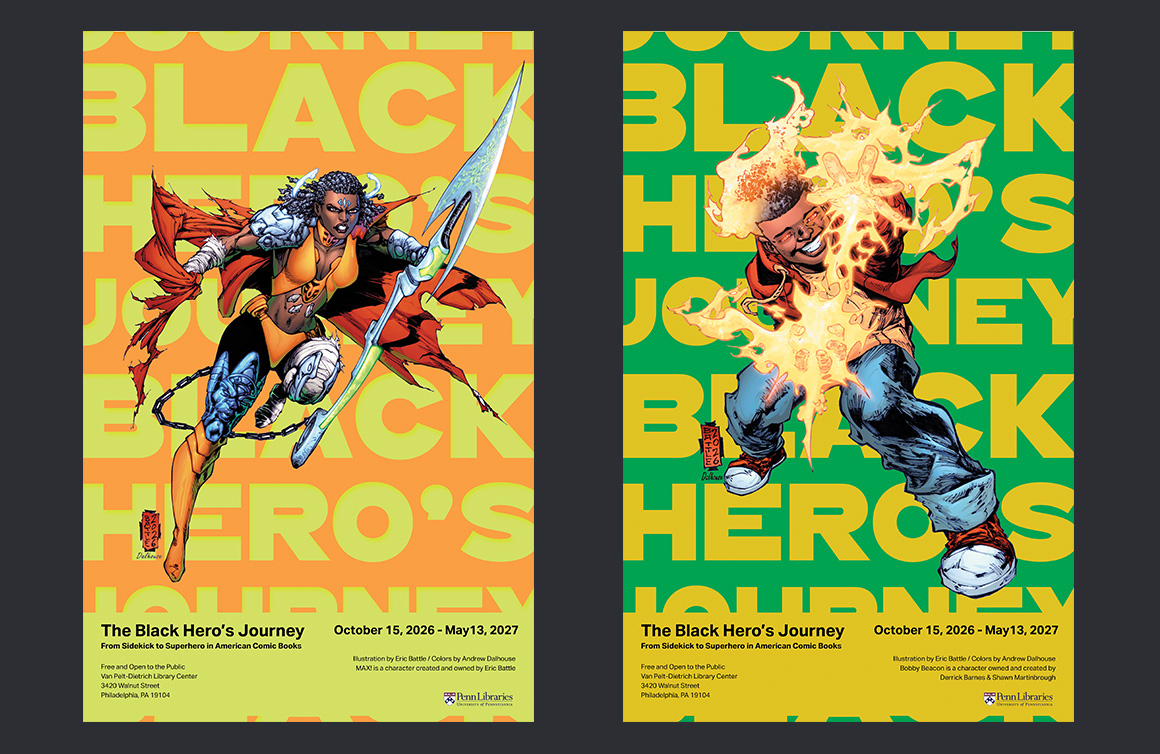
Eric joined the team and really, if I may, brought color to the project through his artistic vision. We were sort of writing a script, and he really has metaphorically and literally illustrated this project.

How did you decide which characters and creators to include in the exhibit, given how many influential figures there are to choose from?
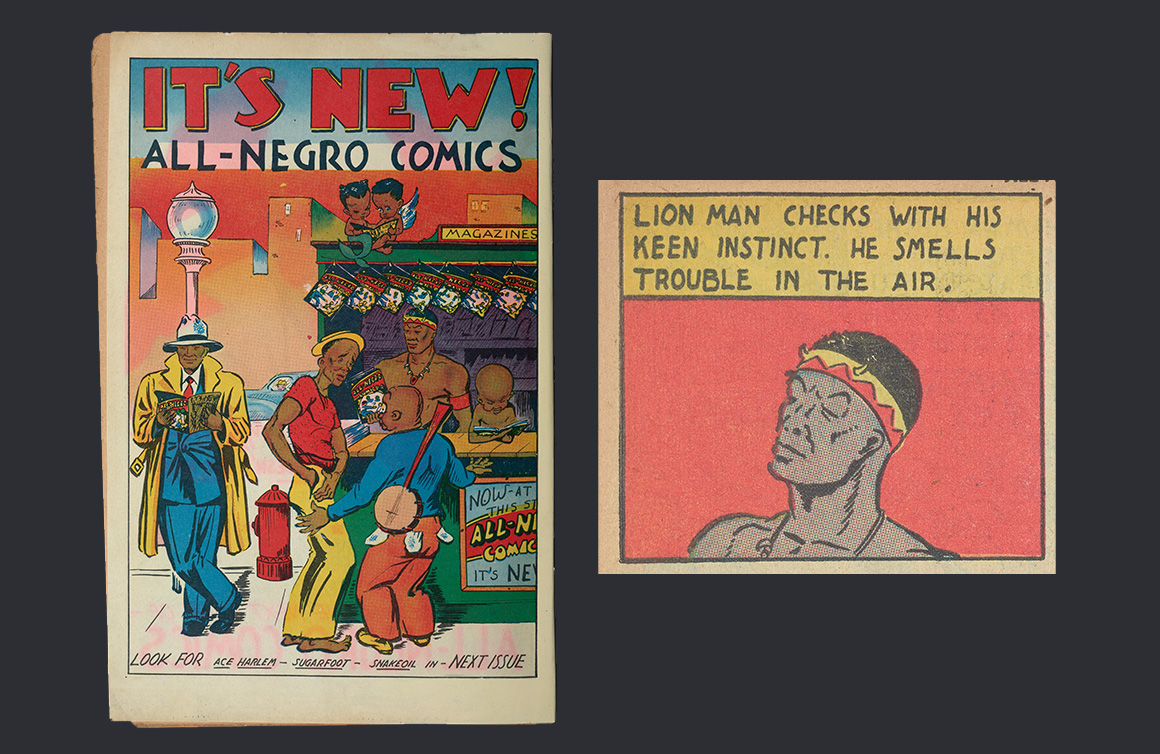
Eric: Philadelphia has such an incredible imprint on the industry. The first and only issue of All-Negro Comics was produced right here in the city, and that was the starting point we could build on, recognizing that there are a number of creators here in Philadelphia. You’ve got folks like Dawud Anyabwile and his brother Guy A. Sims who produced several issues of Brotherman comics. You’ve got Jamar Nicholas, Reggie Byers, Paris Cullins, and a whole host of others.
Chaz: As Eric said, representing Philly is one of the pillars. Then there’s the educational piece, highlighting older, foundational characters who may not have the same recognition as major characters who’ve appeared in movies and television shows.
But there are also very popular Black characters, like Black Panther, Black Lightning, and Storm, whom we also want to lift up.
So, it really comes down to three pillars: popular characters, local and regional creators, and introducing visitors to important figures, characters, and creators they may not know about in the broader history of Black comics.
Eric: We’re also highlighting real-life heroes who have helped make Philadelphia the city it is today, which puts a fantastic spotlight on the city. That ties into the educational piece, letting young people know that the city they live in has a rich history of activism. Sometimes we don’t recognize the excellence that surrounds us.
The exhibit explores underground comix and the Afrofuturism movement. What roles did those two elements play in Black comic book history?
Chaz: That’s a big one. I really love that you’ve distilled those two sub-genres, sub-themes, because it’s such an important part of it.
I think the first step I would take would be underground comics, but I think this transcends comics. I think with underground anything there’s something revolutionary about that. Things go underground because they’re either forced underground and aren’t allowed to be mainstream, or their messages aren’t allowed to be mainstream. And you know, this underground movement allows for a freedom of expression, a freedom of the message that is undomesticated and untamed and unbowed.
And they don’t necessarily have to be revolutionary. They can be funny and alternative in a lot of ways. But there’s freedom when the primary concern isn’t how many copies you’ll sell, how much money you’ll make, or how widely your work will be distributed. It’s about being a free creator who wants to create freely. There’s something deeply powerful about the act of creation itself, let alone the messages in so many underground comics.
Regarding Afrofuturism, there is, in a moment of despair, in a moment when Black stories are not only marginalized but there’s an attempt at erasure, it is hard to hold out hope for our future. Afrofuturism, in many ways, is an act of hope. It is sort of creating a world where we are free, a beautiful world where there is equality, where there is creativity, and beauty. It also points to Black brilliance. When you see Wakanda portrayed on the screen or portrayed on the page, it’s not only a place of Black leadership and Black love, but it’s also a place of Black technology and Black scientific research. It shows the brilliance of a people. It’s not only a call about what could be, but it’s a reflection of what is, but what’s often missed and denied.
It’s really two beautiful sub-themes, sub-genres within Black comics. I love that you asked about them.
How has the portrayal of Black comic heroes and their stories evolved over the decades?
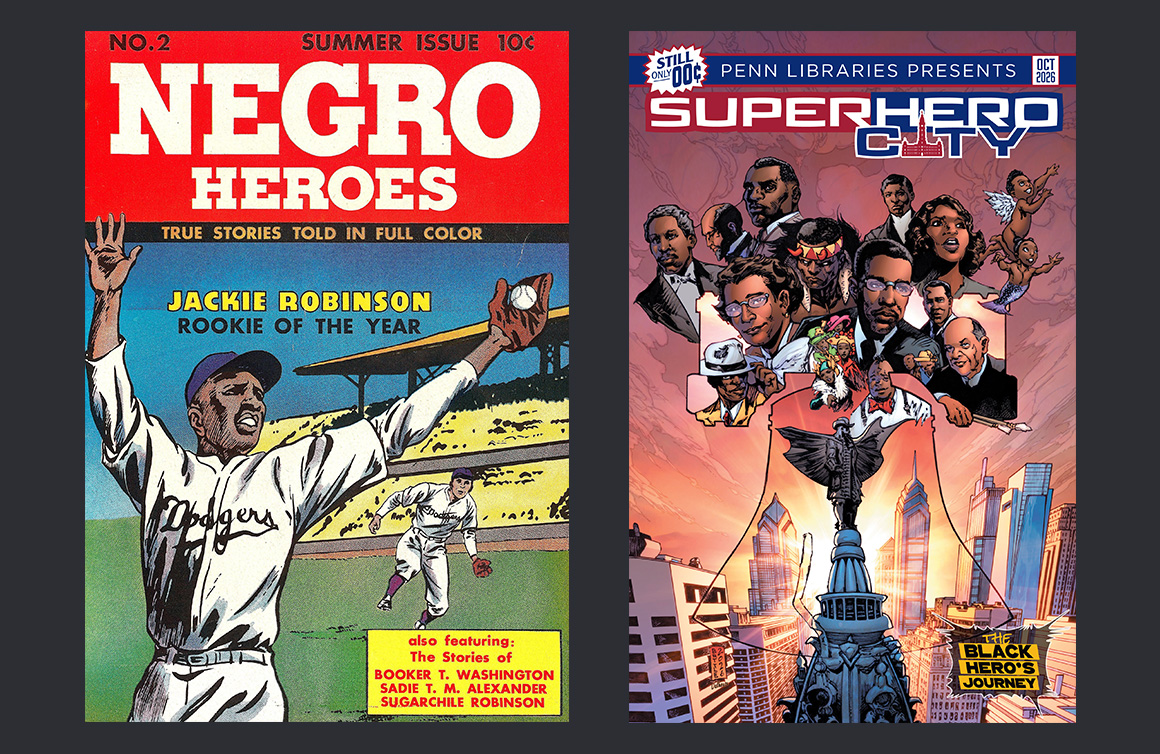
Eric: That’s a theme in the exhibit. Black characters in the early days of comics were often depicted in stereotypical fashion, and not the best representations of us.
What I found most disturbing about those sorts of depictions was that comic books are like a team sport. You’ve got groups of people coming together: a writer, an artist, letterers, and a publishing company. So when you see derogatory images published by a comic book company, even like an advertising agency, those images were approved by a number of people, and that is mind-boggling. Those images were made public because that was a group decision. That’s disturbing to me.
Thankfully, over the years, more African American comic book creators have been able to have their work seen, and more African American editors have been involved in decision-making meetings. Having different voices in those rooms is incredibly important. That’s how we’ve started to counteract the nonsense that came before.
I’d say the rise of the Black Age of comics movement, especially the independent creators, doesn’t necessarily need or want to be beholden to a mainstream comic book company to show images that reflect me. Many independent African American comic book creators have developed their own platforms and avenues to bring their ideas to the rest of the world.
The truth is, the mainstream industry has been watching. The first Black Panther movie was made because the mainstream industry saw the rise of the independent African American comic book movement, and they saw how much money was being generated, and finally recognized that there’s a legitimate audience here that we can and need to tap into. That first Black Panther movie made, what was it, a billion dollars. That says it all. Even when the mainstream may deny you, you can be sure they’re still watching.
Chaz: As Eric was talking, I was imagining that this exhibit wouldn’t have happened 100 years ago. In some ways, it would have been very difficult to identify Black creators back then. The few who existed were kind of undercover. And there were just far fewer characters in the Golden Age, at the dawn of the comic book period. You were only Black characters as caricatures, stereotypes. And then they are barely supporting characters as you move into kind of the mid-20th century when you have a sprinkling of Black characters who are members of a team, but don’t really advance the plot.
But now, we have Eric as one of the curators on this project, and it’s being held here at a university, and we’re lifting up all these creators. We had more Black characters in comics than we could include in the exhibit. It’s amazing.
There’s still so much that needs to happen. There aren’t enough Black creators, or certainly enough Black owners of publishing companies and people in management. We have much further to go, but it’s staggering how far we’ve come.
What would you most like visitors to take away from their experience at the exhibit?
Eric: For me, I hope they walk away from the exhibit feeling proud that we’ve put a spotlight on the city, that they see themselves in what’s being reflected in the exhibit, and that they recognize they can contribute to the exhibit in moving forward with their own ideas. You know, it doesn’t stop here at this exhibit.
I’m from the neighbourhood, I went to neighbourhood schools, and I still live here. I look forward to talking to young people who visit the exhibit and letting them know that comics have taken me far beyond the neighbourhood, and they can do it too.
Chaz: I hope they learn more about comic books and discover things they never knew, whether it’s realizing a particular comic was created by a Black writer or illustrator, seeing Storm’s first appearance, or learning something new about Tala.
I also hope they gain some insight into Black history and the Black liberative arc that’s here, including both its beautiful and painful aspects. I want people to enjoy the exhibit, but also to grow, learn, and be surprised by what they discover.
Where would you recommend readers start if they are just beginning to explore Black comic heroes?
Chaz: I think if a Black character has grabbed your heart before, I’d encourage you to do a deep dive. Do a quick Google search of their first appearance, and then stay with that character.
If you really enjoyed the Black Panther movie, for example, find his first appearance in Fantastic Four and then Black Panther #1, and read those old comics. There’s some cool stuff, and some not great stuff too. Then fast-forward to more contemporary comics and see what Ta-Nehisi Coates did with the character.
If you really like the Black Lightning television show, jump into it there. I think that’s one easy way to get started.
If you’re coming from an artistic standpoint, find a couple of artists and explore their work. For example, if you are drawn in by Eric’s art, he’s illustrated a whole lot of different really cool comics. Look for them and check them out.
Eric: One of the things that we’re doing with the exhibit is putting together a timeline of the characters and creators. Visitors will be able to walk away with at least a timeline/map of the first appearances of some of their favourite characters. There will be an informational timeline, and on the other side will be a collage of these African American characters.
We’re also looking to have an artist desk where visitors can draw their own characters. I always tell people, especially young creators, never discount your own ideas because somebody’s going to be looking for whatever it is that you’re doing. The thing is, you have to do it.
They can start with their own interests, and hopefully that inspires them to branch out, develop their own ideas, and create their own favourite characters.
The Black Hero’s Journey runs at the University of Pennsylvania Libraries until May 13, 2027. The exhibition is free and open to the public.