

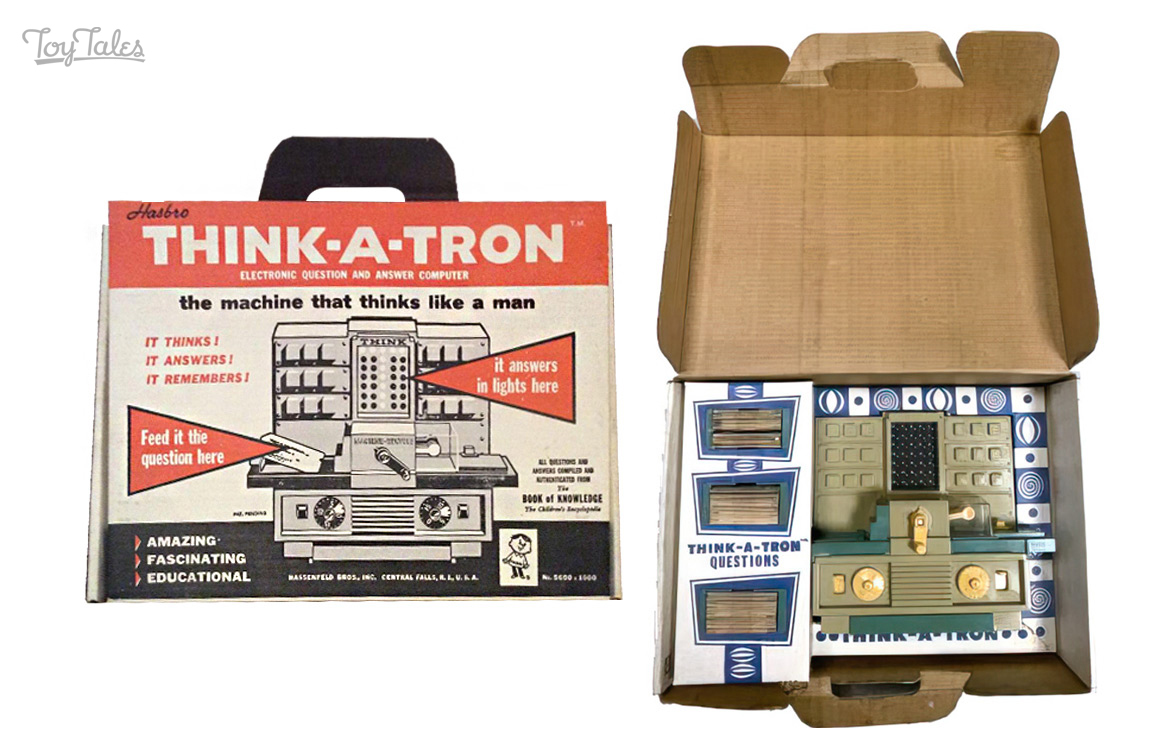
Released in 1960, Hasbro’s Think-a-Tron was an educational toy inspired by the mammoth room-filling mainframe computers of its era. Powered by two D-batteries, it was one of the first educational computer-based toys marketed to children. Since computers were still relatively unfamiliar to the general public, Hasbro added to the intrigue by marketing the Think-a-Tron as “the machine that thinks like a man.”
Like computers of the period, Think-a-Tron used punch cards to process information. The toy came with 150 double-sided cards containing 300 multiple-choice and true-or-false questions. The questions and answers were drawn from The Book of Knowledge: The Children’s Encyclopedia, published by The Grolier Society.
Kids matched wits with the Think-a-Tron by first taking turns guessing the answer to a question on a punch card and then feeding the corresponding punch card into the machine. Think-a-Tron “read” the card and illuminated a letter on its answer panel corresponding to the correct response. It was an impressive display of “compute power” for a toy at the time. Two dials on the front of the toy allowed players to keep score.
Like most trivia games, repeated Think-a-Tron play often resulted in exhausting the 300 available questions provided. To keep things fresh, Hasbro marketed additional question packs for the toy, which were sold in sets of 50 questions.
COLLECTOR CONSIDERATIONS
Think-a-Tron can be found on the secondary market in varying condition. Collectors should look for examples retaining the original punch cards, as they were essential to the toy’s operation and could easily become separated from the machine. The card-reading mechanism, illuminated answer panel, and scoring dials should also be checked for proper operation, while the battery compartment should be inspected for corrosion or other damage.

Note: If you buy something using the eBay link in this story, we may earn a small commission. Thank you for supporting independent toy journalism!