



What first drew you to tabletop role-playing games (RPGs), and what has kept you engaged with them over time?
I sort of came to role-playing games because they were somewhat forbidden.
The cartoon, Dungeons & Dragons, I think from ’83 to ’85 was a source of fascination for me, but I could only catch it intermittently. It felt unpredictable, so it was just sort of this thing that existed. There was also the toy line and the role-playing games, and all of those things were sort of on my periphery.
My mom didn’t really understand what Dungeons & Dragons was and couldn’t really understand the game. There was also the “satanic panic” at the same time, which gave it a sense of a “is this good for my kid?” vibe. So, I didn’t have any Dungeons & Dragons toys as a kid, and she tried to prevent me from getting the role-playing materials.
I think that supercharged my interest.
Eventually, I convinced a grandparent to buy me some of it. Once my mom saw what it actually was, she said, “Wow, this is ridiculous. Yeah, whatever. They’re books. Books are always good.”
Playing and engaging with them has sustained my interest. There’s nothing quite as satisfying or exciting as an in-person role-playing game week to week. It’s a unique intersection between social interaction and storytelling. You get to hang out with friends, and you get to experience this story that you’re a part of.
All of the surrounding elements, including the artwork and the idea of imaginative reading, have always fascinated me.

How have RPGs evolved over the decades, both in terms of gameplay and the communities around them?
I could talk about this forever.
Many intricate details affect this, and my views on them are constantly changing, so I’ll keep it brief.
There has been a vast evolution since 1974, when the first role-playing game, Dungeons & Dragons, was created by Gary Gygax and Dave Arneson. They built it out of Midwestern wargaming traditions, and everything about that game reflected that community.
In the immediate aftermath, other role-playing games tried to “fix” it, thereby helping diversify the player base. That diversification changed the games in significant ways over time. The early creators were middle-class, white, well-educated men with the free time to play long wargames. Those factors shaped the early games.
As time went on, the audience became younger, more urban, and more diverse, and the games evolved accordingly. In the 1980s, as the audience got younger, cartoon properties were adapted into role-playing games, including Teenage Mutant Ninja Turtles and even Rocky and Bullwinkle. Licensing helped reach people who didn’t quite understand how these open-ended games worked. They weren’t like traditional games—there were no winners or losers. That was actually part of the concern during the satanic panic era, that these games didn’t “end” and allowed you to do anything, without real moral consequences—because, of course, it’s just a game.
In the 1990s, things became much more edgy. There was influence from British comics like Watchmen and that tone carried over into role-playing games. The goth scene also became involved with games like Vampire: The Masquerade. The audience kept shifting, and the games shifted with it.
In the 21st century, the player base has become incredibly diverse. There is more representation, particularly in LGBTQ+ identities, and there’s really a game for almost any interest. Where it used to be dungeon-crawling with swords and monsters, there are now games about everyday life, mystery, or even cooking.
It reflects the full range of interests in the community today.
RPGs have, at times, had a complicated public reputation. Do you see any parallels between how RPGs were perceived in the past and how video games have been discussed more recently?
I think that, because it’s historically more distant, the controversy around role-playing games now seems almost quaint.
Video game controversies were tied first to gambling and later to violence, often connected to real-world events. There was never really anything substantial behind the controversies around role-playing games. There were attempts to link them to a few incidents, but nothing meaningful stuck.
For Dungeons & Dragons, which was the main target, the controversy actually boosted sales and helped establish its dominance.
With video games, the proposed link to violence became more of an existential threat in the late 1990s and has never really gone away. It still lingers in a way that it does not for role-playing games.
Role-playing games are also a much smaller community. Even with millions of players, it is still far smaller than video, card, or board games.
Through your Vintage RPG podcast, what stories or themes have surprised you the most as you’ve explored the history of the games?
There are a couple of things. The hobbyist domination by Dungeons & Dragons is endlessly both frustrating and surprising.
Role-playing game players often see themselves as outsiders who want to do things differently, yet many still play the mainline game. While there is a broader world of role-playing games, the entry point remains narrow..
I also find the industry’s boom-and-bust cycle fascinating. Because the space is so small, and because Dungeons & Dragons has such influence, it shapes the entire ecosystem. We are currently in a period of contraction following the post-pandemic peak. These cycles repeat consistently.
Another surprising aspect is how much the RPG space remains DIY and community-oriented. The barrier between players, customers, and creators is very low. Most designers begin as enthusiasts. That is unusual compared to other industries.
What role do you think role-playing games have played in shaping broader toy and play culture?
Even though the audience for role-playing games is relatively small, they have had a disproportionate influence on play culture.
You can see this influence in video games very early. Both video games and role-playing games emerged around the same time, and a crossover happened almost immediately. One of the earliest dungeon-crawling video games appeared on the PLATO system in 1976.
Role-playing game mechanics translate easily into digital systems. Many are math-based and suited to automation. Today, these mechanics are everywhere in video games, including systems like skill trees and hit points.
TBoard games have also been influenced, particularly through dungeon-crawling and adventure-style games like Gloomhaven.
In toy culture, especially in the 1980s, role-playing games were part of a broader wave of fantasy toys. That influence continues today. Whenever children create rules for play, role-playing concepts tend to emerge, even unconsciously.
I saw this with my own child, who used Plus-Plus pieces to build units and simulate battles. He was essentially creating his own wargame system without realizing it. It was fascinating to watch that develop naturally.
If someone new to RPGs wanted to explore the hobby through a vintage lens, where would you suggest they start?
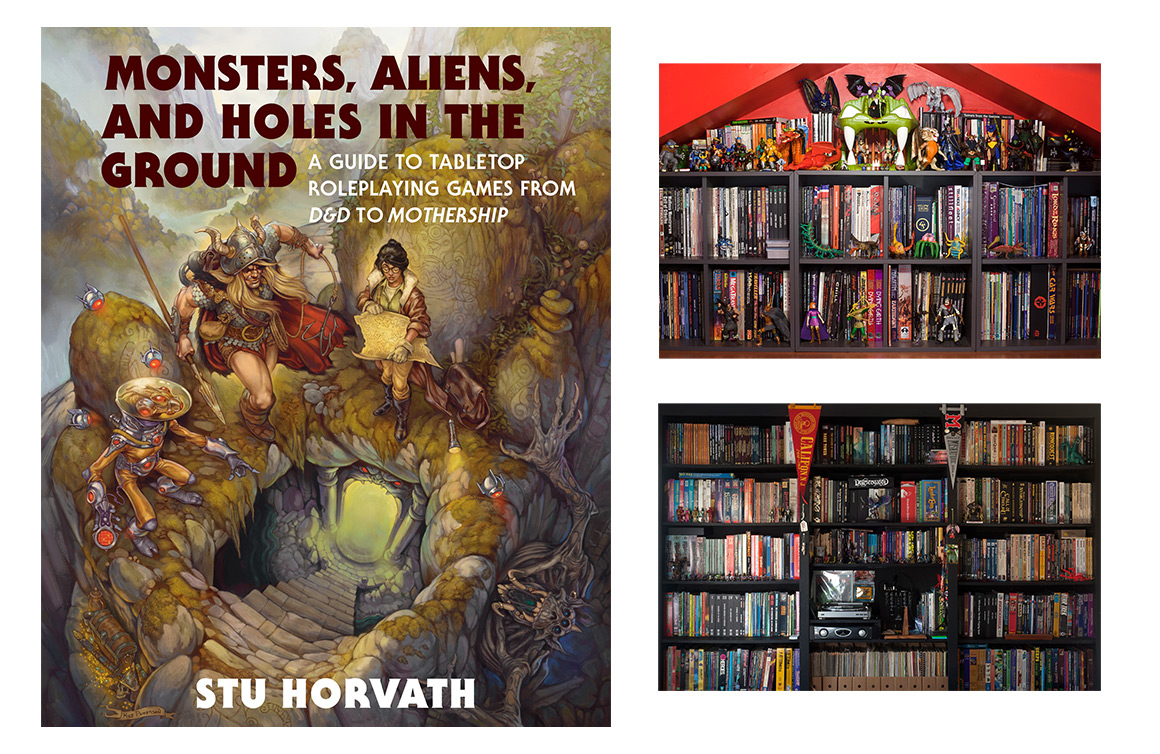
I happen to have written a book about them, Monsters, Aliens, and Holes in the Ground. It’s a decade-by-decade, product-by-product guide to role-playing games. It’s also somewhat of a memoir, reflecting on their importance to me and to the wider culture.
I also recommend Jon Peterson’s book Playing at the World, a deep exploration of the early history of role-playing games, particularly the transition from wargaming.
Aaron Trammell’s The Privilege of Play is also valuable in understanding how early communities shaped the hobby.
If you’re looking for games, there really is something for everyone. Sites like VintageRPG can help you find something aligned with your interests.
For a classic Dungeons & Dragons-style experience, Shadowdark is a modern, streamlined option. Old-School Essentials is another, refining earlier versions of the game.
Beyond that, there is an enormous range of games. One example is Brindlewood Bay, which blends elements of The Golden Girls, Murder, She Wrote, and H.P. Lovecraft. It uses a system where mysteries do not have fixed solutions, and players determine outcomes through play.
There is a large and active community creating games today. From free PDFs to independent zines to larger productions, there are countless ways to explore the hobby.
Visit the VintageRPG website to read more about the genre and listen to the podcast.