
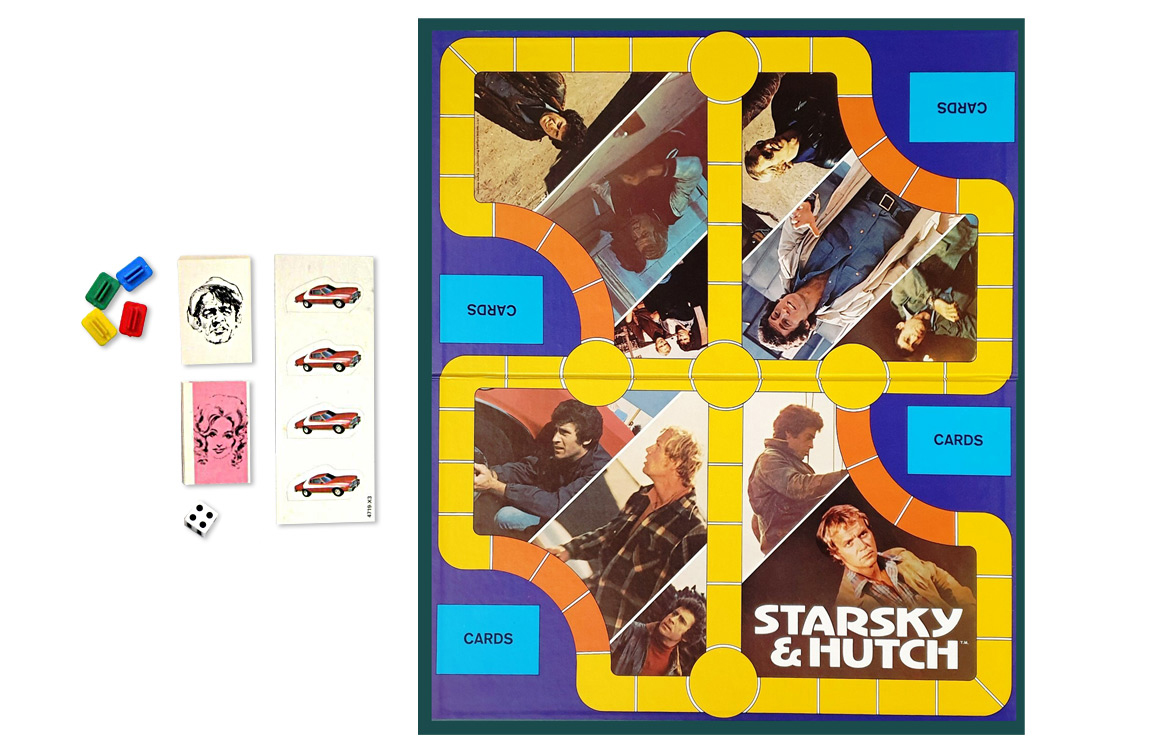
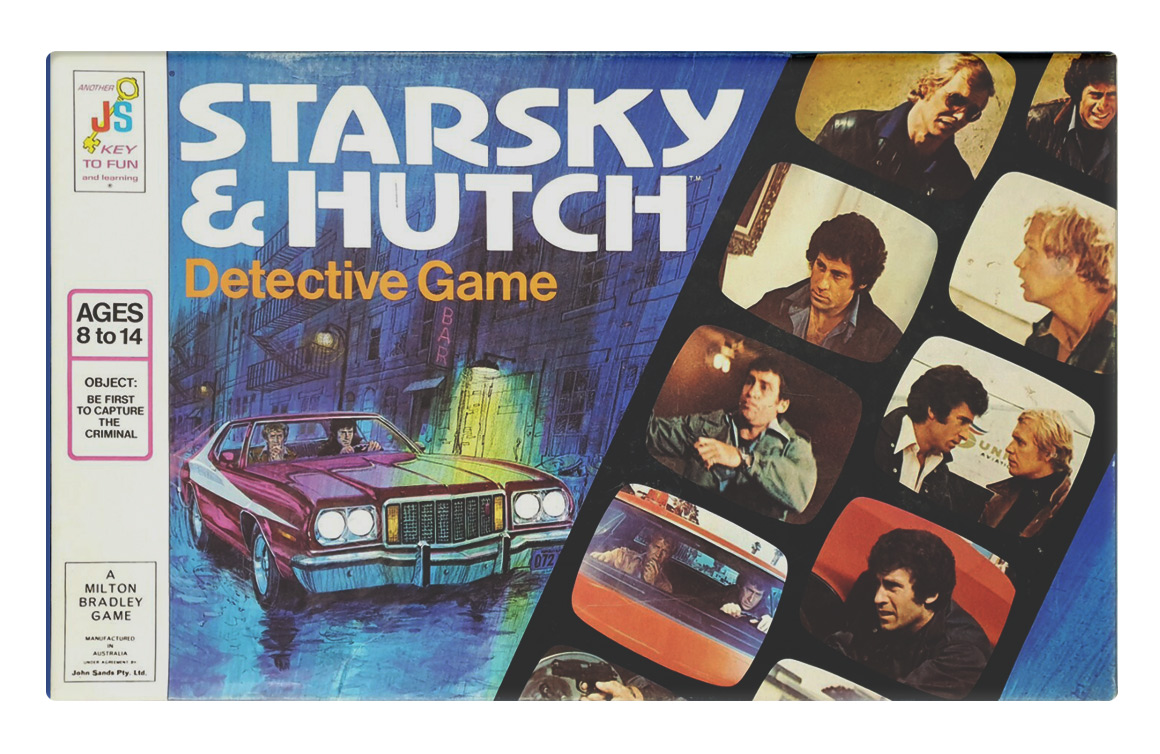
Released in 1977 at the height of the show’s popularity, Milton Bradley’s Starsky & Hutch Game translated the hit television series’ street-level crime drama into a roll-and-move board game format. Players moved custom car tokens around a city-themed game board while attempting to identify and capture a specific criminal. The premise followed the television show’s police pursuit theme, with players collecting information cards and interfering with opponents in order to complete their objective first.
GAMEPLAY
At the start of the game, each player drew one criminal card with a red background. This card identified the player’s target criminal and was placed face up in front of them. The remaining criminal cards were shuffled and dealt face down into four areas on the board marked CARDS.
Players took turns rolling a single die and moving their car token the corresponding number of spaces. When a player landed on a red space by exact count, they drew the top card from the nearest card pile. Cards that matched the player’s target criminal were placed face up in front of the player. Cards that did not match were placed face down in the player’s discard pile.
If a player landed by exact count on a space occupied by another player, they were allowed to draw one card from that opponent’s discard pile and add it either to their matching cards or to their own discard pile. Players were allowed to change direction at the start of a turn, but had to declare the direction before rolling the die.
When the card piles near red spaces were exhausted, players continued play by landing on opponents’ spaces to access discard piles. The first player to collect four cards matching their target criminal won the game.
IN THE BOX
The game included four red-background criminal cards, twenty-eight matching criminal cards, one six-sided die, four Gran Torino style custom car tokens, and four coloured plastic stands in green, yellow, red, and blue.
COLLECTOR CONSIDERATIONS
The Starsky & Hutch Game is relatively common on the secondary market, with copies appearing regularly in mixed condition. Complete examples are less common due to frequent loss of smaller pieces and wear from play.

Note: If you buy something using the eBay link in this story, we may earn a small commission. Thank you for supporting independent toy journalism!