 Level up. It’s Mar10 Day.
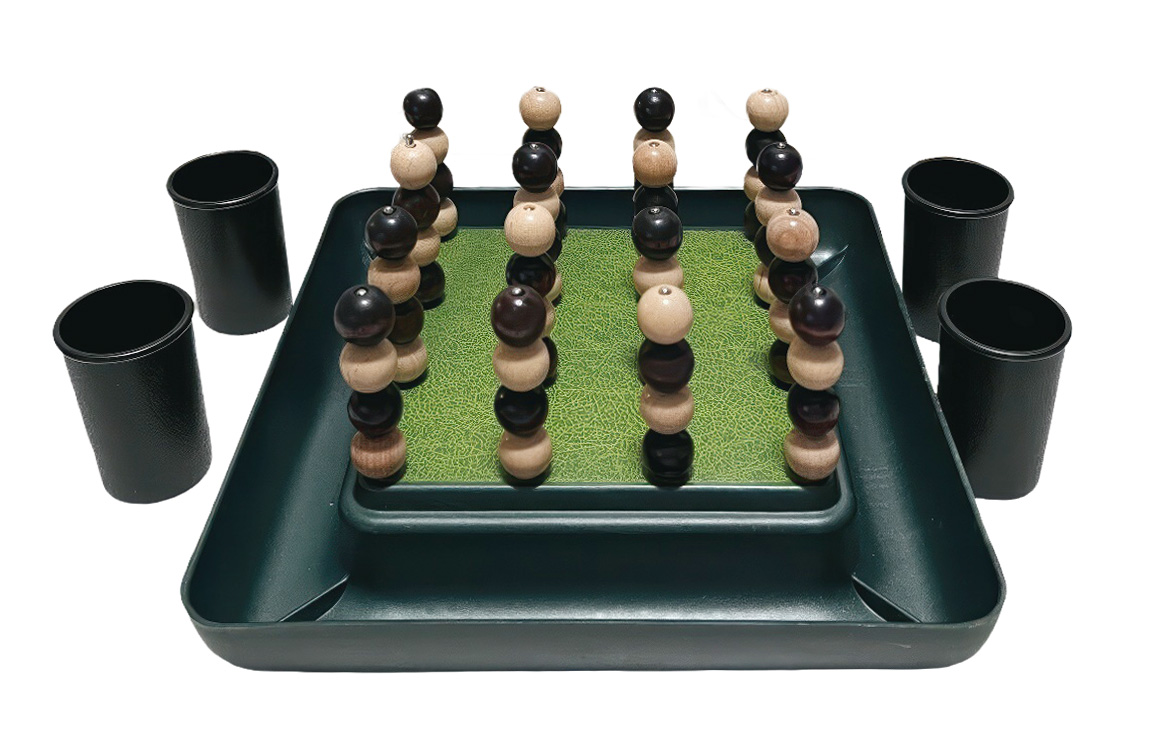
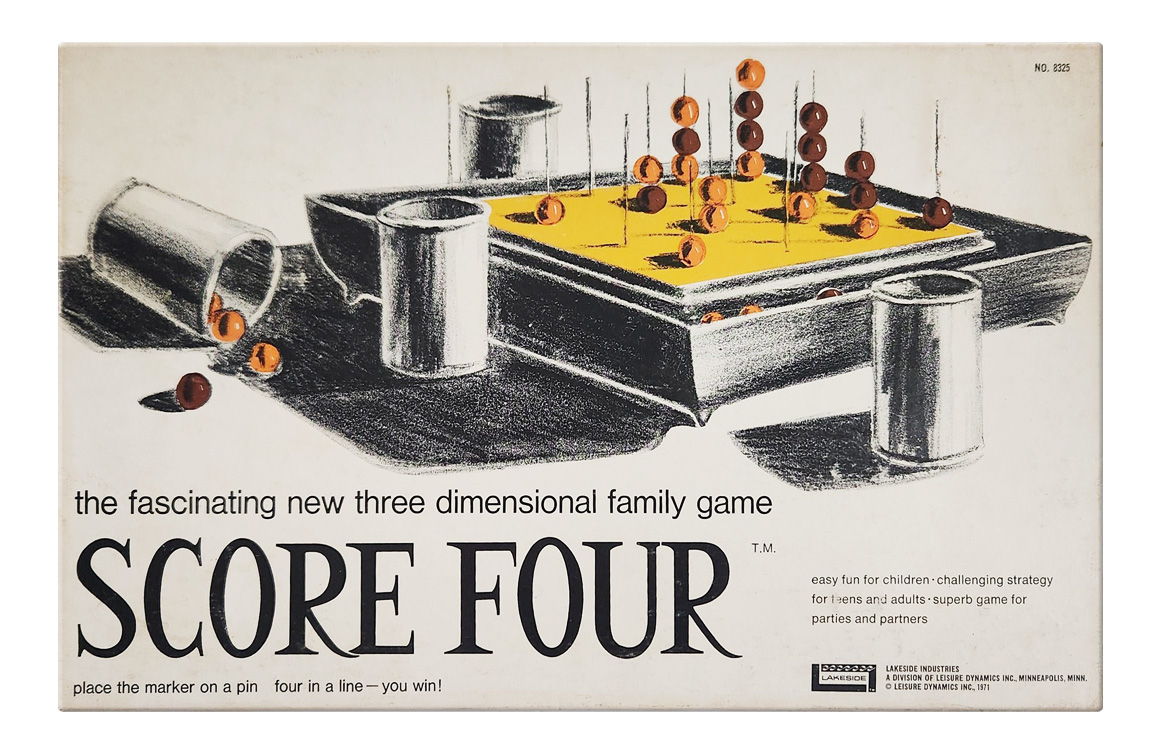
Released in 1971 by Lakeside, Score Four (No. 8325) was a three-dimensional strategy game that challenged players to align four markers in a row within a vertical grid. Marketed as “the fascinating new three-dimensional family game,” it combined simple rules suitable for children with the deeper strategic possibilities designed to appeal to teens and adults.
The object of the game was straightforward: position four beads of the same colour in a straight line on any level or angle within the plastic grid base. Unlike traditional tic-tac-toe, which is played on a flat surface, Score Four expanded the concept into three dimensions. Players placed wooden beads onto metal rods arranged in a 4 × 4 grid, building upward through four levels as the game progressed. Winning combinations could occur vertically, horizontally, diagonally, or along angled lines through the structure.
GAMEPLAY
Play typically began with two players choosing bead colours and alternating turns by dropping a bead onto any rod. A move was completed when the bead was released onto the rod. A level did not need to be filled before players could build upward, allowing strategic positioning across multiple layers. A win occurred whenever a player formed four beads of the same colour in a line, at which point the player would call “Score.”
The game could also be played in partnership or team formats. Four-player games paired partners, while larger groups could divide into teams of up to eight. Advanced scoring methods introduced tournament-style play and point systems that rewarded lines formed at different levels within the grid.
IN THE BOX
A complete Score Four set includes the plastic grid base, sixteen metal rods, sixty-four wooden beads (32 light and 32 dark), and four scoring cups. The rules were printed on the inside of the box top.
COLLECTOR CONSIDERATIONS
Score Four appears regularly on the secondary market in varying conditions. Collectors should ensure they’re purchasing a complete set, as Missing rods or beads are common, and plastic grid bases may show cracks or warping from use.

Note: If you buy something using the eBay link in this story, we may earn a small commission. Thank you for supporting independent toy journalism!