
“It’s fun… It’s creative… It’s imaginative…”
Released by Ideal in 1954, Robert the Robot was one of the earliest mass-produced toy robots in the United States and the first to be made of plastic. He was produced using injection moulding, allowing Ideal to manufacture him in large quantities at a lower cost than earlier tin robots.
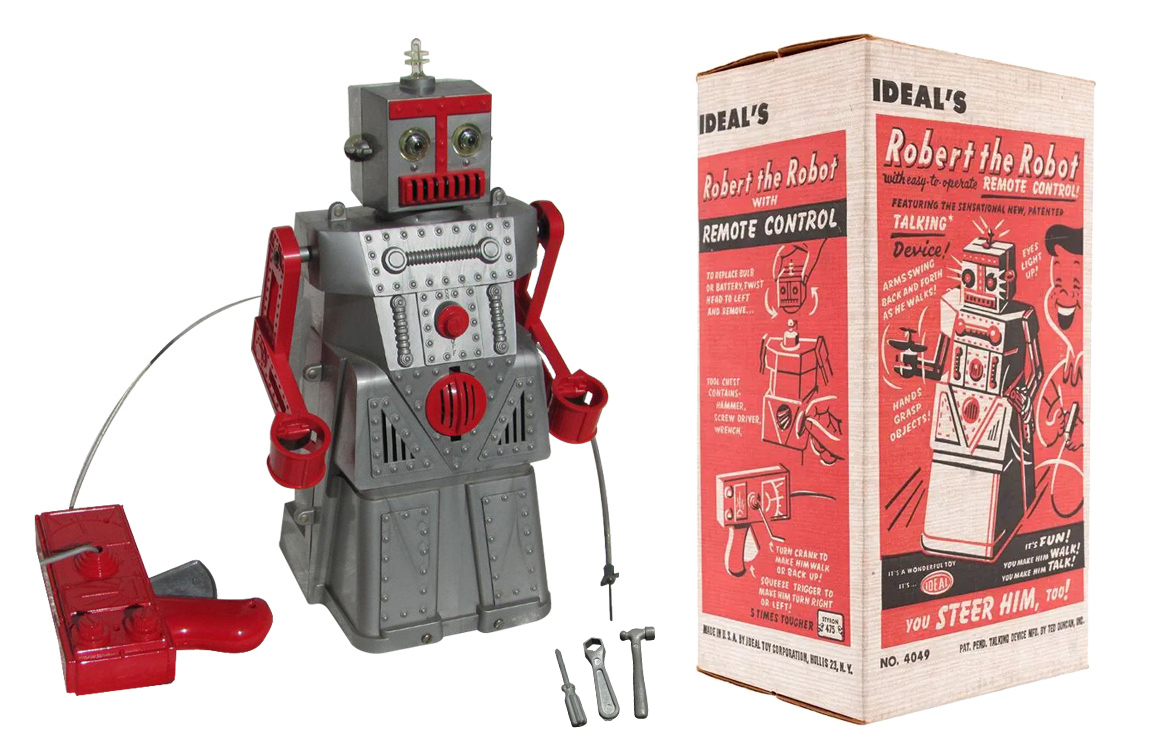
Robert stood just over a foot tall and was operated by a wired, gun-shaped controller. The mechanical remote enabled him to move forward, backward, and to the left or right. Turning the chest knob activated light bulbs behind his transparent eyes. His articulated arms were equipped with moulded hands designed to clutch small objects. A handle on his back powered the Duncan Talking Device, allowing him to speak the recorded phrase, “I am Robert Robot, mechanical man. Drive me and steer me wherever you can.” Developed and patented by Ted Duncan, Inc. of California, the mechanism functioned as a miniature, hand-cranked record player that used a small disc and diaphragm to reproduce sound. A battery housed in Robert’s head powered the lighted eyes, while the remote’s trigger allowed him to be steered left or right.
VERSIONS & DESIGN CHANGES
Each version of Robert introduced between 1954 and 1956 was simplified from the one before it. It appears Ideal made these adjustments to reduce production costs to remain at a competitive price point with Marx’s Electric Robot, a rival battery-operated knock-off released shortly after Robert’s debut.
The first version (1954) featured clear plastic eyes and a crown, a red wooden crank handle, and a small compartment in his torso that held three metal tools: a hammer, screwdriver, and wrench. A reflective sheet behind the eyes amplified the light effect.
The second version (1955) removed the tool compartment and reflective head insert, replaced the wooden crank with a black plastic one, and added the embossed patent number DES. PAT. No. D-174,588 to the back of his body.
The third version (1956) introduced grey-moulded eyes and a crown in place of the clear plastic parts. The internal connecting rods that allowed the arms to swing were eliminated, and the shoulders were redesigned to enable manual arm positioning.
POPULARITY & LICENSING
Robert the Robot was the subject of children’s songs, appeared briefly in a Hollywood film, and inspired a small range of licensed merchandise, including T-shirts, flashlights, and other accessories. Approximately 500,000 units were produced before the line was discontinued.
COLLECTOR CONSIDERATIONS
Early examples with the original tool compartment and metal tools are the most desirable, as these accessories were dropped after the first production year. Working examples with the Duncan Talking Device intact and a functional remote are uncommon. Boxed robots, especially those with inserts, tools, and paperwork, command a significant premium.

Note: If you buy something using the eBay link in this story, we may earn a small commission. Thank you for supporting independent toy journalism!