
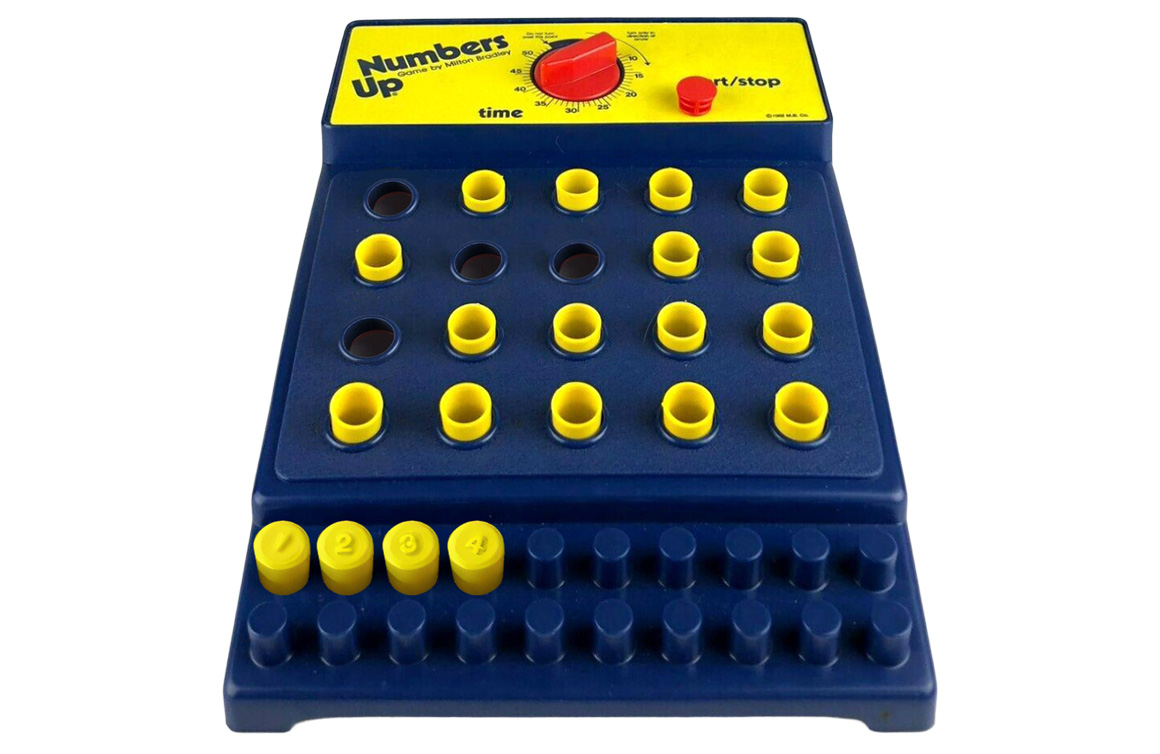

Numbers Up was a fast-paced memory and dexterity game that challenged players to think quickly, remember patterns, and work under pressure. Designed for one or more players, the game combined pattern recognition, recall, and manual precision.
GAMEPLAY
The game base was divided into three primary sections. The top section housed the timer and start/stop lever. The centre section contained four rows of five holes where the numbered pegs were placed upside down at the start of each round. The lower section featured a peg board with two rows of ten pins used to hold pegs once they were correctly identified.
To begin play, the numbered pegs were randomly placed upside down in the centre holes of the game base. A time limit of up to 60 seconds was set, after which one player pulled up the start/stop lever to activate the timer.
The objective was to locate and remove the pegs in numerical order, starting with number one. Only one peg could be handled at a time, and a peg had to be returned to its hole before another could be lifted. When the correct peg was found, it was placed onto the peg board in sequence, and the search continued immediately for the next number. As play progressed, remembering the location of specific numbers became increasingly important.
When time expired, a player’s score was determined by the number of pegs correctly placed in sequence on the peg board. Each player was given a turn, and the winner was either the player who placed the most pegs before time ran out or the one who completed the full sequence of twenty pegs in the shortest time.
The game included optional accommodations for novice players, including the ability to use both hands when turning pegs and the option to set a longer time limit. Solo play was also supported, with players attempting to improve upon their previous scores.
IN THE BOX
A complete game included the plastic game base and 20 numbered pegs. Instructions were printed inside the box top.
COLLECTOR CONSIDERATIONS
Numbers Up was part of a broader category of games that incorporated mechanical timers or pressure-based play to limit turn length. Similar games such as Electronic Radar Search Game from Ideal, Operation from Milton Bradley and Them Bones from Mego used audible sounds to signal a task failure, while Perfection from Lakeside relied on timed or failure-triggered mechanisms to govern play. Collector interest in these games typically centred on the condition and functionality of the timing components, as wear or damage often affected gameplay.
Watch a classic commercial for Numbers Up on the Toy Tales YouTube channel.

Note: If you buy something using the eBay link in this story, we may earn a small commission. Thank you for supporting independent toy journalism!