


How do you describe your collection?
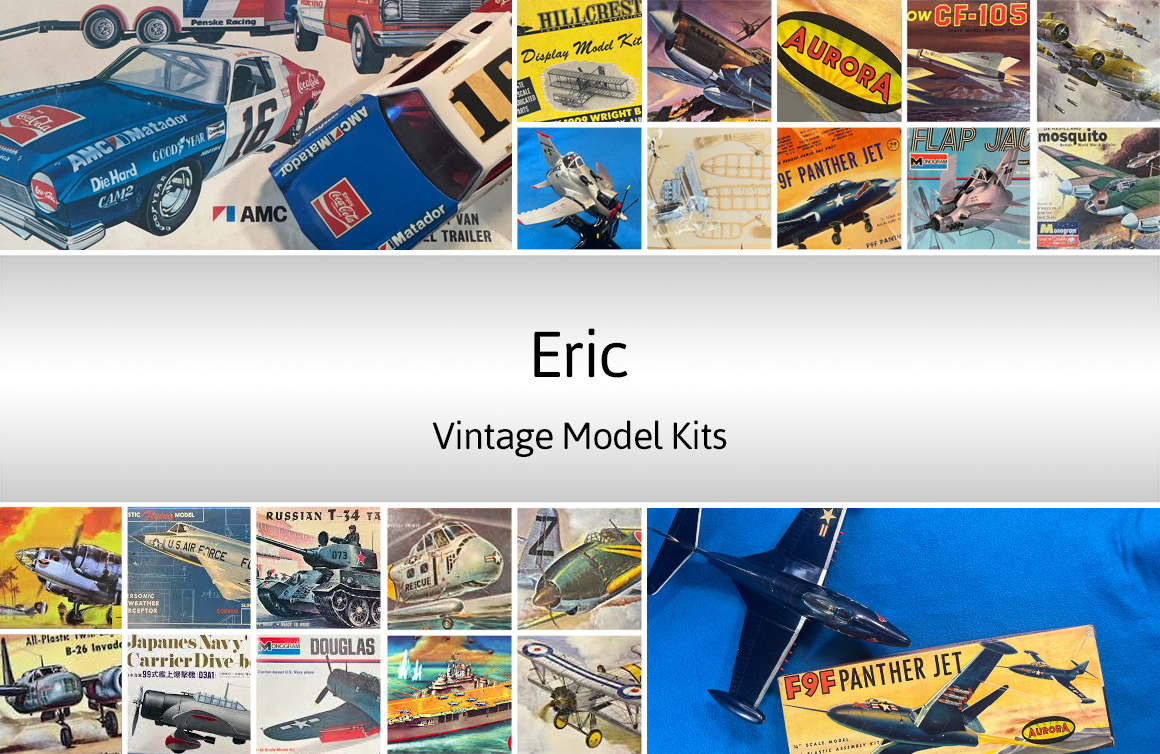
My collection currently consists of 672 model kits, mostly vintage examples dating from the 1930s through the early 1980s, with the bulk from the 1950s to 1970s, which I consider the golden age of model kits. I have a few newer kits sprinkled in, mostly aircraft that I find visually interesting.
I originally started modelling in the 1970s, attending early swap meets to trade kits with other builders. Back then, it was about building, not collecting. Older kits from the 1940s to 1960s were often dismissed as simple or crude, but I picked up a few because they were inexpensive.
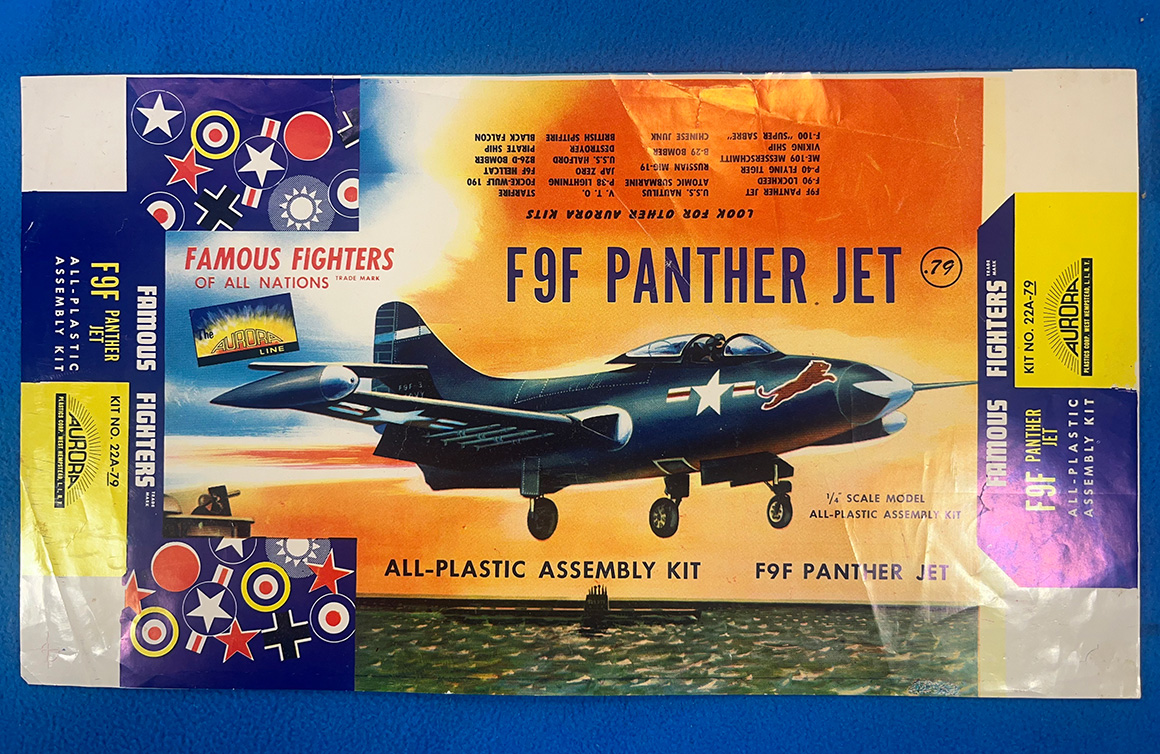
Over time, swap meets evolved into collector shows, influenced in part by the 1980s boom in baseball card collecting. I became interested in the box art of older kits, even when the kits themselves lacked detail. At one point, I won a 1950s Aurora Panther jet kit as a door prize. I didn’t build it at that time because, in my view then, it was garbage kit with no real detail, so it sat in my drawer for decades.
Fast forward about 30 years, and I got back into modelling during COVID. I revisited some of the old kits I still had and rediscovered that Panther jet. This time, it really intrigued me. It reignited my interest and led me to start seeking out older kits again.
Today, I focus on building kits the way a kid would have in the 1950s, using tube glue, hand-painting, and avoiding modern airbrushing to recreate that original experience. Many of the wood kits I feature come from my father’s collection, which he built before plastic kits became common.

When and why did you start your collection?
It began as an effort to preserve a small piece of model kit history. I went online looking for information for my own knowledge, and found there was a lack of really good sources documenting older model kits. I decided to try filling that void, and it turned into far more than I ever thought expected.
In recent years, there have books and publications on major players like Revell, Monogram, Aurora, and some British companies such as Airfix and Frog. That information is valuable, but for smaller or more obscure manufacturers, even ones that still exist, there’s very little documentation. That’s where my interest settled, researching and preserving those overlooked stories.
Another element I’ve always found fascinating is the box art. The artwork on older kits was phenomenal, created by artists who were truly masters of their craft. I also began researching the model airplanes themselves, the markings, the accuracy of the model, and the real-world history behind them. Some kits focus depict famous pilots or planes, but many are just generic airplanes, and I enjoy uncovering their stories.
Through this research, I discovered that roughly a third of the kits I’ve reviewed depict aircraft connected to real-life tragedy. Manufacturers often copied reference photos without knowing the history. Some of these planes were involved in accidents or combat, and lives were lost. While famous pilots are well remembered, many others are not. My videos try to bring attention to those lesser known stories and moments of heroism.
This all ties back to my childhood. My dad was a model builder in the late 1940s and 1950s and continued into adulthood. He bought me my first kit, and we built it together, sparking my interest in aviation and history. That curiosity never faded. Fifty years later, I own more than a thousand books on aviation, along with uniforms and flying gear from World War II. It has become a lifelong passion.
I built a lot of models as a kid and teenager, but as I got older, other things like dating took precedence. Model building was considered pretty nerdy back then, so I stepped away from it for a while. During COVID, stuck at home, I thought, “What am I going to do? Oh yeah, I used to build models.” I started again and reacquired some of the kits from my youth. One of them, the Aurora B-26 Marauder, a notoriously inaccurate kit, but one with amazing box art and nostalgia value. I plan to rebuild it not to a much higher standard than I did as a kid.
I really started to considered myself a collector about five years ago, when I started building models again and returning to swap meets. Seeing the old 1940s and 1950s kits, along with their artwork and nostalgia, really spoke to me, even though I hadn’t lived in that era. Prices dropped after COVID, making it easier to acquire kits relatively cheaply, especially as older collectors downsized and younger builders showed little interest in vintage kits. It was the perfect moment to start a collection.
I enjoy building vintage kits the way they were originally intended, using tube glue and brush painting. Modern kits are hyper-realistic and can take months to complete, but older kits can be built in a day, letting you relax and enjoy the process while ending up with a neat little airplane for display.
Returning to shows and connecting with other collectors inspired me to start a YouTube channel. I wanted to share what I was learning and create a forum for discussion. I found a couple of good channels, like Celebrating Aviation with Mike Machat and Max’s Models, which covered a variety of topics, including vintage kits, though that wasn’t the main focus. That convinced me there must be others out there who wanted to learn more.
The channel has grown into a small but engaged community. People share information in the comments, email me details I hadn’t known, and some creators, like Max, have become friends. The channel now has nearly 3,000 subscribers and over half a million views, which is significant for such a niche topic. Some videos, like a one-to-one scale 1960s Civil War pistol kit by Pyro, take off unexpectedly.
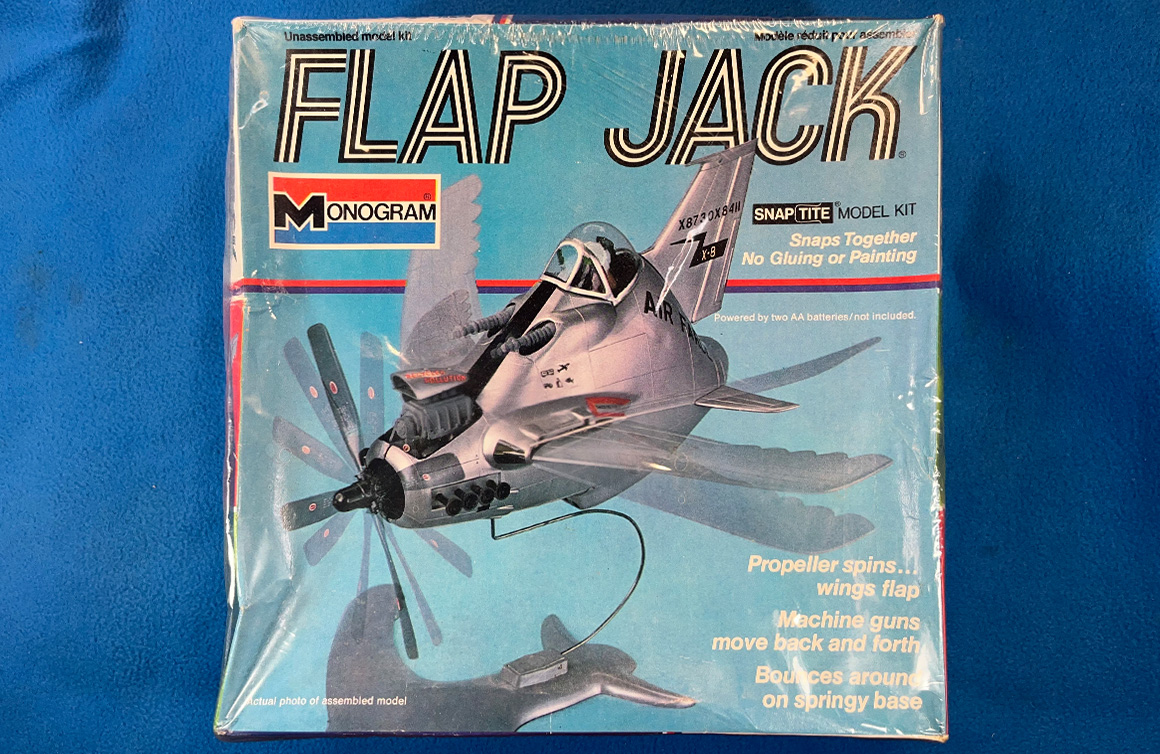
One of my favourite projects involved a Monogram Flap Jack kit that my dad and I built when I was six or seven. I played with it until it fell apart. Recently, I found two more examples, reviewed the kit, built it again, and added a little extra flair. It was fun and deeply meaningful, reconnecting me to that early experience.
How do you display and store your collection?
Most of the kits are still unbuilt. I simply don’t have as much time to build as I’d like, completing maybe one kit every couple of months. I have a few display cabinets, but they’re already full, so finished models are stacked to keep them dust-free. They’re not displayed the way I’d prefer, and I would need more room to do that properly.
I recently downsized from a 2,500-square-foot house to a 1,200-square-foot apartment after my kids finished school and moved out. I’m still sorting through everything, so display space is limited at the moment.
The kits themselves are organized into clear plastic tubs by manufacturer, which are stacked for storage. I also maintain a spreadsheet listing all the kits I own.
The spreadsheet tracks the manufacturer, subject, kit number, year of release, scale, condition of the kit and box, and additional remarks. Those remarks note things like first issues or unusual features, such as a series from Hawk that used chrome-plated plastic to create a bare-metal finish. That’s how I keep track of everything.
It’s especially useful at collector shows, helping me confirm whether I already own a kit. I can usually recall when and where I acquired most of them, but every so often I double-check the list. Thanks to modern phones, I always have it with me.
What do you consider to be the Holy Grail of your collection?
That depends on how you define it.
The rarest kit I own is from a company called Hillcrest. They appear to have produced only two kits in the late 1940s: a Wright Brothers Army Flyer and a Curtiss Pusher. One of them represents a transitional moment between traditional stick-and-tissue wood construction and injection-moulded plastic, though it was still covered in tissue. It’s extremely rare, but beyond that, it doesn’t excite me all that much.
For me, the most exciting kit is an Aurora Panther jet I won at a show in the 1970s. It’s simple, with bright plastic and raised panel lines, but the box art, memories, and connection to the film The Bridges at Toko-Ri make it my favourite. If I had to keep only one kit, that would be it.
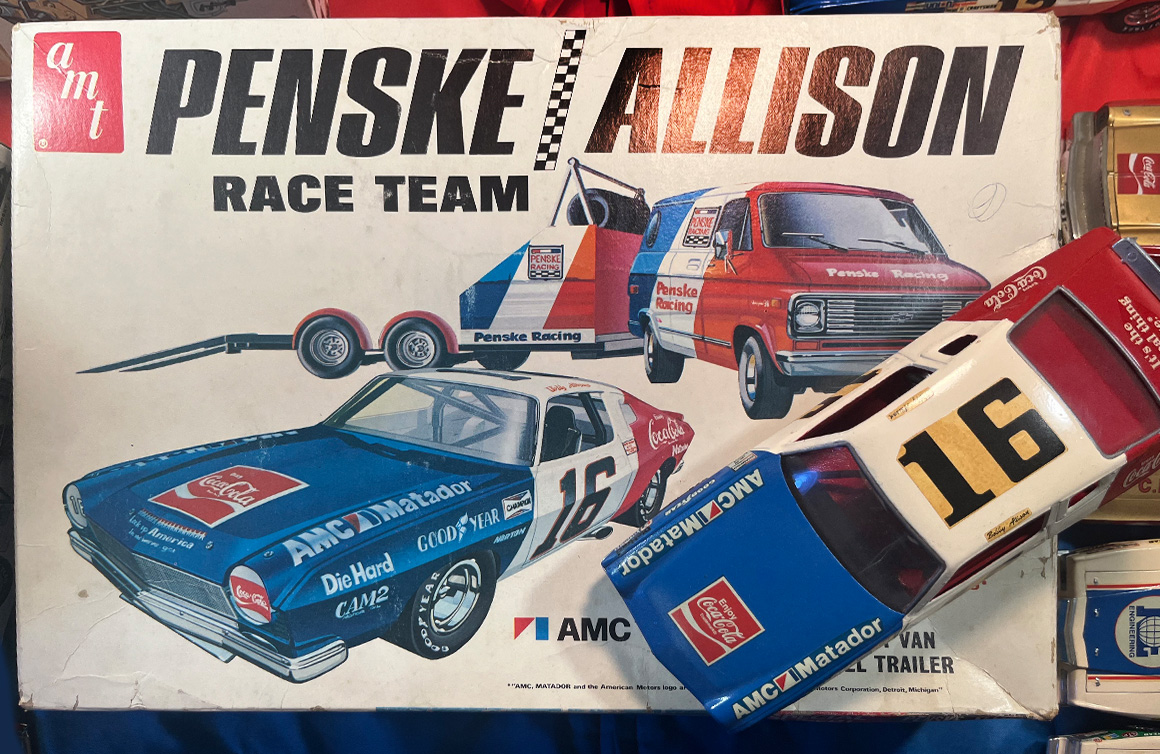
Another long-standing interest of mine has been NASCAR racing, which I watched with my dad. Bobby Allison was our favourite driver because he drove the red, white, and blue AMC Matador. It doesn’t get much more American than that. One of the first car kits I ever received was the Bobby Allison race team kit, which included the car, van, and trailer. It was far too complex for me at the time and eventually disappeared. About fifteen years ago, my dad and I came across one at a collector show, and he bought it for me. That was a long-lost holy grail finally satisfied.
After that, my focus shifted to the Dick Trickle A&W Root Beer Mustang. I’ve been searching for it in person for about 20 years. It’s rare because it was only issued once, and the mould was later reused for other Mustang kits, so it can’t be reissued. Prices have climbed from around $100 to $300, which I won’t pay. I did pick up its empty box for $5, but I still haven’t found a complete kit.
In general, I don’t spend much on kits. Most cost between $5 and $20. I’m drawn to rare or unusual kits, especially the obscure ones that you wouldn’t normally see, like Civil War pistols or even the UN building. Those oddities are some of the most fun to collect.
What advice would you give to someone interested in starting a vintage model kit collection?
One common debate on my YouTube channel is whether to build kits or keep them sealed. Some of the kits I feature are still unopened. Older kits often weren’t shrink-wrapped, just taped at the corners. When I open one on camera, some people react strongly. My view is simple: enjoy them.
None of these kits is the last sealed example on Earth. That rare Hillcrest kit is an exception, but most others exist in significant numbers. These kits were made to be built. If you want to build them, build them. If you prefer collecting for the box art, that’s fine too.
The biggest challenge I’ve encountered is kit completeness. Sometimes parts are missing, and you don’t discover it until you get home. Whenever possible, inventory a kit before buying it to avoid disappointment.
Above all, don’t feel that your kits have to sit untouched. They were meant to be used and enjoyed.
See more of Eric’s collection on his Celebrating Vintage Model Kits YouTube channel.
Drop us a line to let us know about your collection of vintage toys and/or games. We just may feature your collection!